Marketers: Fix AI Search Visibility With 5 KPIs and 15–25 Prompts

AI search visibility is how often and how prominently your brand shows up in AI-generated answers, measured through two distinct signals: mentions (your brand named in the response) and citations (a clickable link back to your source). The fastest way to start measuring it is to open the Generative AI performance report inside Google Search Console for Google’s AI surfaces, then layer in weekly prompt tests across ChatGPT, Perplexity, and Gemini to catch what Google’s report can’t see.
TL;DR:
- Most AI search visibility is driven by mentions for brand recall and citations for high-intent traffic, which behave differently across engines.
- Google’s AI features depend on existing page indexing and structured data, making technical eligibility checks a critical first step before optimizing content.
- Marketers should focus on tracking AI impressions, citation share, mention rate, traffic from AI, and volatility to accurately gauge visibility across multiple engines.
- Building a comprehensive measurement system involves integrating Google Search Console data with regular prompt tests on ChatGPT, Perplexity, and Gemini.
- Starting with an audit and establishing a repeated testing framework can reveal visibility gaps and guide effective content and technical improvements.
Table of Contents
- What Does AI Search Visibility Actually Measure?
- How Do You Actually Measure AI Search Visibility?
- What Technical Requirements Gate AI Search Visibility?
- What Should Be On Your AI Search Visibility Action Checklist?
- Building a Hybrid Dashboard: Which KPIs Actually Matter?
- Building This System Without Starting From Zero
- The Measurement-First Case Nobody Argues Against, But Almost Nobody Practices
- Get Your AI Search Visibility Measurement System Built Right
- Sources
What Does AI Search Visibility Actually Measure?
Two words carry most of the weight here: mentions and citations. A mention is your brand named inside an AI-generated answer, no link required. A citation is the answer engine actually pointing back to one of your pages, usually as a clickable source. Both matter, but they serve different goals. A mention builds brand recall even when nobody clicks through. A citation drives the kind of high-intent traffic that converts, because the person clicking already trusts the AI enough to follow its recommendation.
The engines behave differently enough that treating them as one channel is a mistake. Google’s AI Overviews and AI Mode draw directly from the core Search index, so a page’s existing SEO health largely determines whether it gets pulled in. ChatGPT leans on a mix of its own retrieval layer and, for many queries, live web browsing. Perplexity is citation-heavy by design and tends to surface a longer list of sources per answer than the others. Gemini sits closer to Google’s own index behavior but shows more variance in which sources it surfaces on a given day.
That shift changes what the funnel looks like for marketers. Answer engines increasingly resolve a query without a click, which means:
- Total organic clicks for some query types will keep declining even as brand awareness holds steady or grows.
- The clicks that do happen from AI citations tend to arrive further down the funnel, closer to a buying decision.
- A brand can lose click volume and still gain share of voice, which is exactly why mention tracking matters alongside citation tracking.
- Pages built to answer one specific question well tend to outperform long, unfocused pages in getting cited.
None of this means classic SEO is dying. It means the scorecard needs two more columns than it used to.
How Do You Actually Measure AI Search Visibility?
Start with what Google already gives you for free, then fill the gaps it can’t cover.
- Open the Generative AI performance report in Google Search Console. It shows how often links to your site appeared inside a generative AI feature, broken out by page, query, country, device, and date.
- Export impressions by page. This is the step most teams skip. The dashboard view is fine for a glance, but the export lets you sort by page and spot which content is already earning AI placement.
- Cross-reference top AI-featured pages against your highest-value conversion pages. If your best-converting product page never shows up, that’s your first fix target.
- Build a prompt-test log for the engines Google Search Console doesn’t cover. Pick 15 to 25 prompts that map to your core buyer questions, run them on a fixed schedule (weekly or biweekly), and record whether your brand was mentioned, cited, or absent.
- Track volatility, not just presence. A brand that shows up in 80% of relevant prompts one week and 40% the next has a stability problem worth investigating before a visibility problem.
There’s a real limitation to know about before you build a report around Search Console’s data: the report explicitly labels itself preliminary, and chart totals can differ from table totals because of how Google aggregates by property versus by individual page.
Pro Tip: Treat the exported table, not the summary chart, as your source of truth for page-level decisions. The chart is useful for spotting trend direction; the table is what you act on.
Vendor dashboards fill in what Search Console can’t touch, since it only covers Google. Tools built for answer-engine tracking, including free one-time snapshot graders like HubSpot’s AI Search Grader, typically report mention counts, citation share against named competitors, sentiment, and a source list showing exactly which pages got pulled into an answer. Free graders are fine for a baseline gut check. If you need trend data over months, you need something that runs continuously, not a one-time snapshot.
What Technical Requirements Gate AI Search Visibility?
Here’s the part most teams get backward: no amount of well-written, answer-shaped content will show up in Google’s AI features if the underlying page isn’t indexed and snippet-eligible in the first place. Google is direct about this: generative AI features are built on top of the same index and quality systems that power regular Search results. Eligibility is a gate, not an optimization tactic, and it comes before everything else on this list.
Run these checks before touching a word of copy:
- Confirm the page isn’t blocked by
robots.txtand doesn’t carry an unintendednoindextag. - Check that the canonical tag points to the version of the page you actually want indexed.
- Verify the page sits in your XML sitemap and that the sitemap itself is submitted and error-free in Search Console.
- Run a
site:yourdomain.com/page-urlsearch to confirm Google has the page indexed at all. - Check the URL Inspection tool in Search Console for indexing errors or crawl issues specific to that page.
Once a page clears that bar, content structure starts to matter; learn more about how to optimize content for AI search. Google explicitly recommends keeping content crawlable and accessible so its models can ground answers in real, retrievable pages rather than guessing. Clear, answer-first paragraphs help here, and so does structured data. Markup from Schema for products, FAQs, and organizations gives AI systems a machine-readable shortcut to the exact facts they need, rather than forcing them to parse dense prose to find a price or a spec.
Pro Tip: If a page fails the index check, fix that first and stop optimizing its copy. Rewriting content on a page Google can’t see is wasted effort.
What Should Be On Your AI Search Visibility Action Checklist?
Once eligibility is confirmed, the work splits into four buckets. Tackle them in this order, because content and source signals depend on the technical layer already being solid.
Content fixes:
- Rewrite key pages so the first two sentences answer the core question directly, before any brand framing or context.
- Update FAQ and product pages so each question-and-answer pair could stand alone as a citation, with no dependency on surrounding page context.
- Build topic hubs that cluster related questions and link them together, since answer engines reward depth on a subject over scattered, shallow pages.
Source signals:
- Publish original research, data, or documentation that positions your brand as the primary source on a topic, not a summarizer of someone else’s.
- Keep pricing, specs, and policy pages current, because AI systems will cite a stale competitor page over your accurate one if yours is out of date.
- Earn mentions on authoritative third-party sites; citations compound when multiple credible sources agree on the same fact about your brand.
Structured data and feeds:
- Add Product, FAQ, and Organization schema to the pages most likely to answer buyer questions directly.
- Keep Merchant Center feeds and other product data current; AI shopping features pull from the same feeds that power standard shopping results.
Operational routines:
Review server logs periodically to identify which AI crawlers (GPTBot, PerplexityBot, Google-Extended, and similar) are actually hitting your site, and confirm none are being blocked accidentally. Schedule your prompt-sampling runs on a fixed calendar so volatility tracking has clean week-over-week data instead of gaps. Prioritize the content backlog by multiplying GSC AI impressions by each page’s conversion potential, then weigh in how often that same page already shows up in your prompt tests.

Pro Tip: A page that gets AI impressions but zero conversions probably has a mismatch between what the AI answer promises and what the page delivers. Read the actual AI-generated snippet before you touch the page.
Building a Hybrid Dashboard: Which KPIs Actually Matter?
A single-engine view of AI visibility will always understate reality, because Google Search Console only reports on Google’s own surfaces. The fix is a composite dashboard built on two data streams: GSC exports for Google, and logged prompt-test results for everything else.
Five metrics belong on that dashboard:
- GSC AI-feature impressions by page, pulled directly from the export, tracked as a trend line rather than a single snapshot.
- Citation share, the percentage of tested prompts where your brand got an actual clickable citation rather than just a mention.
- Mention rate, the broader measure of how often your brand gets named regardless of whether a link appears.
- AI-referred traffic, isolated in analytics where possible to separate it from standard organic sessions.
- Volatility index, a simple week-over-week swing calculation that flags instability before it becomes a trend worth panicking over.
Weight Google-first, since it’s still the highest-volume answer surface for most categories, and treat strong cross-engine presence as a multiplier rather than an equal-weighted fourth input. A brand dominant on Google but invisible everywhere else has a real gap worth closing, but it’s a different problem than being invisible everywhere.
Report on three cadences: weekly for volatility checks (fast enough to catch a sudden drop), monthly for the full KPI snapshot leadership actually reads, and quarterly for the strategic review where you decide what gets rebuilt, rewritten, or retired based on where Google’s own guidance says visibility is heading next.
Building This System Without Starting From Zero
Quicktoimpress builds exactly this kind of measurement layer for clients who don’t have months to figure it out through trial and error. Because the same team that designs the roadmap also builds it, the typical starting sequence runs in four stages: an audit of current AI and search eligibility, construction of the measurement layer (GSC integration plus a documented prompt-test framework), a prioritized roadmap ranked by impact and effort, then implementation and automation of the fixes. For multi-location brands and enterprise commerce teams managing dozens or hundreds of pages, that sequencing matters more than any single tactic, since platform-level engineering work is what makes the fixes stick instead of drifting back to broken within a quarter.
The Measurement-First Case Nobody Argues Against, But Almost Nobody Practices
Most AI visibility advice jumps straight to tactics: write answer-first content, add schema, chase citations. All reasonable, none of it wrong. But it skips a step that determines whether any of it works: you have to know your baseline before you optimize against it, and most teams don’t.
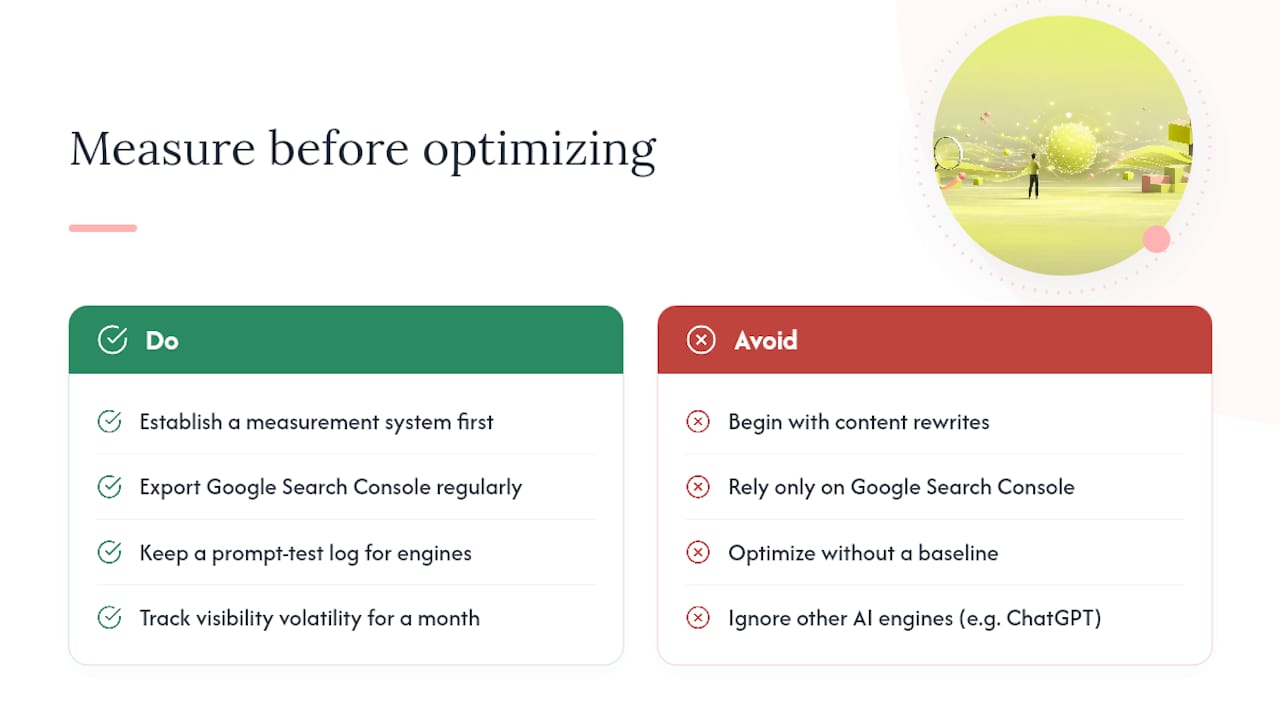
The conventional advice treats AI visibility like classic SEO with a new dashboard. It isn’t. Classic SEO gave you one system (Google Search) with one measurement source. AI visibility spans multiple engines with different retrieval logic, and Google Search Console only tells you about one of them. Teams that build their entire strategy around GSC data are flying blind on ChatGPT, Perplexity, and Gemini, often the exact engines where a younger, more research-driven buyer is asking questions first.
What should come first isn’t a content rewrite. It’s the measurement system itself: the GSC export habit, the prompt-test log, the volatility tracking. Build that, run it for a month, and the content priorities become obvious instead of guessed at.
— Service
Get Your AI Search Visibility Measurement System Built Right
Most teams patch together a GSC export here and a manual prompt check there, then wonder why the resulting picture never quite adds up. Quicktoimpress builds the actual system: GSC integration, a repeatable prompt-testing framework across ChatGPT, Perplexity, and Gemini, and the dashboard that turns both into one composite visibility score your team can act on without a spreadsheet marathon every month.
That’s the gap between reading about a hybrid measurement approach and actually running one. Quicktoimpress pairs the senior strategists who design the KPI framework with the engineers who wire it into your existing marketing stack, so the roadmap doesn’t stall at the recommendation stage. If your team manages content across multiple locations, a complex product catalog, or a stack with more moving parts than one dashboard can currently show, the AI search and automation service is built specifically for that scope. Start with a scoped audit: request one through the Quicktoimpress site and get a prioritized list of eligibility fixes and measurement gaps before committing to anything larger.
Sources
- Generative AI performance report (Search) - Search Console Help
- Developers
- What is AI Visibility and How do I Measure It? — Conductor