Use Five Pillars in Your API Integration Strategy for DevOps

An API integration strategy aligns every connector your systems use to a specific business outcome, using repeatable patterns, documented data contracts, and real operational monitoring. The goal is predictable, maintainable integrations, not a pile of one-off scripts nobody wants to touch. Start by inventorying every integration you run today, then rank each one by business impact and how likely it is to break.
TL;DR:
- Over half of enterprises manage hundreds to thousands of integrations, making ad-hoc connectors a costly and fragile maintenance burden.
- Defining scope, ownership, SLAs, and business objectives before coding is essential to prevent quick integrations from becoming permanent liabilities.
- Key pillars such as security, resilience, observability, data contracts, and governance must be addressed to ensure reliable production integrations.
- Best practices include credential validation at startup, proactive rate limiting, idempotent retries, and systematic observability to prevent common failure points.
- Regularly tracking success, error rates, latency, and vendor updates helps ensure the integration strategy remains effective amid API changes and business growth.
Table of Contents
- What Makes an API Integration Strategy Different From Ad-Hoc Connectors
- The Five Pillars Every Integration Decision Should Pass Through
- How Do You Build an API Integration Strategy Step by Step?
- Which Architecture Pattern Fits Your Integration?
- What Keeps Integrations Reliable in Production?
- How Do You Measure Whether Your Integration Strategy Is Working?
- The Quicktoimpress Take on Integration Strategy
- How Quicktoimpress Builds Integration Strategies That Hold Up
- Sources
What Makes an API Integration Strategy Different From Ad-Hoc Connectors
Most companies don’t choose to build integrations badly. They just add one connector at a time, under deadline pressure, until nobody remembers why half of them exist. MuleSoft’s research found that more than half of enterprises manage hundreds to thousands of applications, and many run into the thousands. At that scale, ad-hoc connectors turn into a maintenance tax nobody budgeted for.
A programmatic API integration strategy treats every connection as infrastructure, not a favor to another team. That means defined ownership, a documented contract, and a clear answer to “what happens when this breaks?”
Before writing a single line of integration code, define scope:
- Which systems are in scope, and which are explicitly excluded for now
- What SLA each integration needs (real-time, near-real-time, or batch)
- Who owns the data on each side, and who gets notified when it changes
- Which business objective the integration serves: faster time to value, lower support cost, or higher developer velocity
Skipping this step is why so many “quick” integrations become permanent liabilities.
The Five Pillars Every Integration Decision Should Pass Through
Every solid API integration strategy rests on five pillars, and weak spots in any one of them tend to surface as production incidents months later, usually at the worst time.
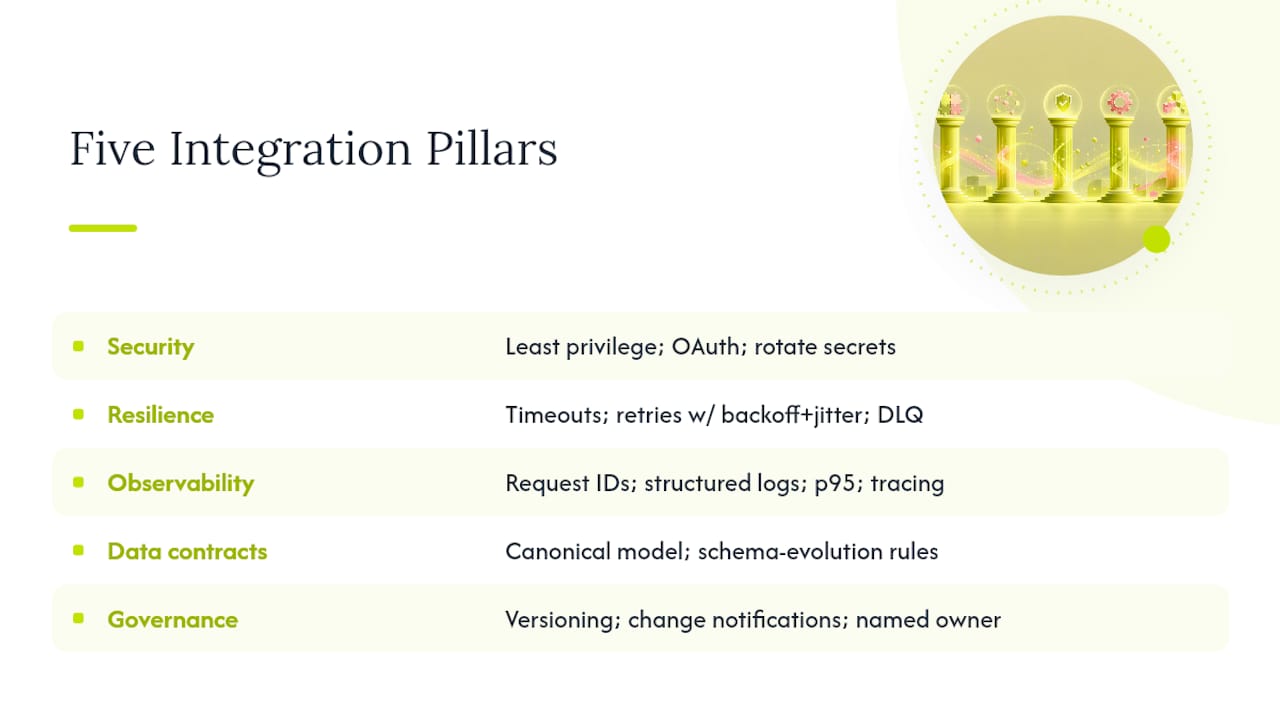
Security starts with least privilege. Scope every credential to the minimum it needs, favor OAuth over static API keys where the provider supports it, and rotate secrets on a schedule rather than waiting for a breach to force your hand.
Resilience means timeouts on every outbound call, retries with exponential backoff and jitter, idempotency keys on writes, and a dead letter queue for anything that fails repeatedly. Guidance from Samioda treats integrations as distributed systems from day one, adding these controls before new features, not after an outage.
Observability requires request IDs threaded through every call, structured logs, p95 latency tracking, and distributed tracing across service boundaries.
Data contracts define a canonical model for shared entities and clear rules for how schemas can evolve without breaking consumers.
Governance covers versioning, change notifications, and a named owner for every connector.
Pro Tip: Assign a single owner to each integration, even the small ones. “Shared ownership” usually means no one gets paged when it fails at 2 a.m.
How Do You Build an API Integration Strategy Step by Step?
A working implementation roadmap follows a sequence, not a checklist you tackle in parallel. Skipping steps to move faster is exactly how teams end up rebuilding the same integration twice.
- Inventory and prioritize. List every existing and planned integration, then rank by business impact and fragility. The connector feeding your billing system outranks the one syncing marketing tags.
- Choose the pattern per workflow. Decide sync versus async, whether a backend for frontend (BFF) makes sense, or if the workflow needs a dedicated integration service.
- Design before coding. Nail down the data contract, the auth flow, and how you’ll handle rate limits, before a developer opens an editor.
- Build the test layer. Sandbox environments, contract tests, and recorded fixtures catch auth failures, retry bugs, and schema drift before they reach production.
- Roll out with guardrails. Canary releases, health gates, and a runbook for common failure modes turn “we’ll find out in prod” into a controlled process.
| Roadmap stage | What “done” looks like |
|---|---|
| Inventory & prioritization | Ranked list with owner, business impact, and risk score per integration |
| Pattern selection | Documented choice (sync, async, BFF, event-driven) per workflow with rationale |
| Contract & auth design | Written data contract, auth flow diagram, rate-limit handling plan |
| Testing | Sandbox coverage, contract tests, and fixtures for token refresh and schema changes |
| Rollout | Canary gate passed, runbook published, alerting configured before full traffic |
This sequence is also where most timelines get compressed under pressure. The step teams cut first, usually testing, is the one that saves the most time later.
Which Architecture Pattern Fits Your Integration?
The right topology depends on who’s consuming the data, how many clients need it, and how much operational overhead you can absorb.
- BFF (backend for frontend): Keeps secrets server-side and centralizes error handling. Strong choice when multiple, mismatched clients (web, mobile, partner apps) need different shapes of the same data.
- Dedicated integration service: Worth the added infrastructure once you have enough connectors that shared logic and centralized ownership pay for themselves.
- Event-driven and webhooks: Decouples systems well, but only holds up if you build idempotency and a replay strategy for missed or duplicate events from the start.
- REST vs. GraphQL: Default to REST for third-party vendors, since most providers only expose REST anyway. Reach for GraphQL when you control the server and need to compose data from multiple sources into one flexible shape, and Samioda’s guidance recommends enforcing query depth and complexity limits so a single request can’t overload your infrastructure.
None of these patterns is universally correct. The mistake is picking one pattern for the whole company instead of matching it to each workflow’s actual constraints.
What Keeps Integrations Reliable in Production?
Most integration failures aren’t exotic. They’re expired tokens, unhandled rate limits, and webhooks that silently drop events. 137Foundry’s analysis identifies authentication and token lifecycle issues as the most common source of hard-to-debug production incidents, which is exactly why credential handling deserves more attention than it usually gets.
Validate credentials at startup rather than discovering an expired token mid-transaction. Store secrets in a proper secret manager, not environment files copied between servers, and rotate them on a schedule.
For retries, apply exponential backoff with jitter, but only on idempotent operations. Cap the number of attempts. Retrying a non-idempotent write can double-charge a customer or duplicate a record, which is worse than the original failure.
Rate limits deserve product-level respect. Read the provider’s rate-limit headers, throttle outbound calls proactively, and queue long-running syncs instead of hammering the API until you get blocked. APIDeck’s best practices recommend cursor-based pagination and idempotency keys stored alongside the business record for every financial write.
Webhooks need their own discipline: acknowledge receipt immediately with a 200, process the payload asynchronously, verify the signature, and dedupe using stored event IDs so a redelivered webhook doesn’t trigger the action twice.
On the observability side, log every outbound call, track error rates and p95 latency continuously, and alert before performance degrades into an outage rather than after.
More than half of large enterprises run integration portfolios spanning hundreds to thousands of connected systems, which is precisely the scale where a single silent failure can cascade across departments before anyone notices.
How Do You Measure Whether Your Integration Strategy Is Working?
Governance isn’t paperwork. It’s what tells you whether the strategy is actually holding up as providers change their APIs and your business adds new systems.
Track a small set of service-level indicators for every integration:
- Success rate and error rate per connector
- p95 latency, not just averages, which hide the slow outliers that frustrate users
- Retry count and dead letter queue depth, both early signals of provider instability
- Contract test pass rate before every deployment
Subscribe to each vendor’s changelog and treat deprecation notices as work items, not surprises six months later. Run contract tests and sandbox validation on every connector before it ships, and use canary rollout gates paired with a runbook for known failure modes so a bad deploy affects a fraction of traffic instead of all of it.
The Quicktoimpress Take on Integration Strategy
Most integration failures come from splitting strategy and execution across different teams that never talk. Quicktoimpress keeps them together. The people who design the roadmap also build and operate it, which is a large part of why multi-location brands, B2B SaaS companies, and enterprise commerce organizations bring in Quicktoimpress when their integration layer has outgrown ad-hoc fixes. Strategy documents that never touch production code are where most integration programs quietly stall.
— Service
How Quicktoimpress Builds Integration Strategies That Hold Up
An alternative to hiring a strategy consultant and a separate implementation team for integration work is to have one accountable partner who designs the roadmap and builds it, so the credential rotation plan, the retry logic, and the monitoring dashboard all come from people who actually maintain them afterward.
For teams managing revenue-critical connectors, from CRM and billing sync to revenue operations across HubSpot, Salesforce, or Pardot, that continuity matters more than another slide deck. Quicktoimpress works with multi-location brands centralizing dozens of local systems, and with growth teams whose stack has outpaced their integration layer’s ability to keep up. For a deeper look at how integration KPIs tie back to broader growth metrics, tracking website performance is worth pairing with your integration dashboards.
If your current integrations are held together by scripts nobody wants to touch, start with an audit: inventory what exists, rank it by risk, and map a prioritized roadmap. Visit Quicktoimpress to scope a pilot engagement and get a concrete plan before your next connector becomes the next incident.
Sources
- How to Build an Integration Strategy | MuleSoft
- API Integration best practices for developers | APIDeck