Ship Edge SEO Fixes in Minutes: A Playbook for Engineers

Edge SEO runs SEO-critical transformations at the CDN layer, using serverless workers so teams can ship redirects, headers, and HTML fixes without touching origin code. The main payoff is speed of change: fixes that would sit in an engineering backlog for weeks go live in minutes, with no deploy cycle and no waiting on a CMS release. Adopt it when origin constraints, legacy platforms, or slow release cycles are blocking SEO changes that need to happen now, not next quarter.
TL;DR:
- Edge SEO enables rapid implementation of redirects, headers, and HTML fixes at the CDN layer, bypassing slow origin code updates in legacy or constrained platforms.
- Streaming HTML rewriters process responses as they flow through, allowing real-time content modifications without loading entire documents into memory, which preserves page speed.
- Correct cache key design is crucial; excluding variables like language or user segments can cause serving incorrect localized or A/B test content, reducing cache efficiency.
- Edge fixes are most effective for structural issues such as resolving redirect chains, managing hreflang tags, injecting structured data, or implementing crawl directives when origin access is limited.
- Proper rollout requires strict validation, staged deployment, and continuous monitoring of cache hit ratios, HTML parity, and Search Console signals to prevent staleness or unexpected content discrepancies.
Table of Contents
- What Edge SEO Actually Means at the Architecture Level
- How Streaming HTML Rewriting and Cache-Key Design Work Together
- Where Edge SEO Actually Pays Off
- How to Roll Out Edge SEO Changes Safely
- What Edge SEO Won’t Fix
- The Quicktoimpress Approach to Edge SEO Projects
- When We Choose Edge Fixes Over Origin Changes
- Get an Edge SEO Audit Built Around Your Stack
- Sources
- FAQ
What Edge SEO Actually Means at the Architecture Level
Every edge SEO implementation sits on the same foundation: a content delivery network running serverless code in the request path, between the visitor (or crawler) and your origin server. Instead of a request going straight to your CMS and back, it passes through a worker script that can inspect, modify, or replace that response before it ever reaches the requester. That’s the entire trick. No origin deploy, no CMS plugin, no waiting for a sprint.
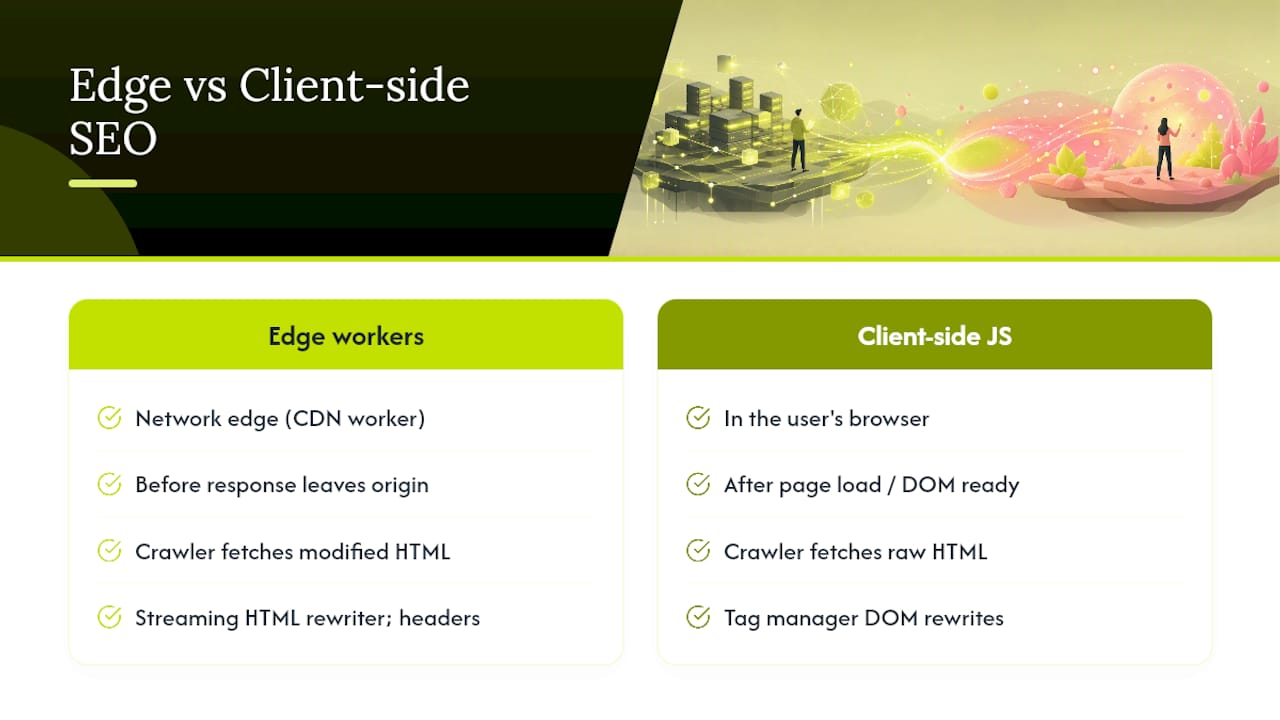
This differs fundamentally from client-side JavaScript fixes that manipulate the DOM after the page loads. A tag manager script that rewrites a title tag runs in the browser, after Googlebot has already fetched the raw HTML, which makes rendering and timing a gamble. Edge workers modify the response before it leaves the network, so what a crawler fetches is what you intended it to fetch. Search Engine Land describes edge SEO as exactly this: implementing SEO changes at the network edge via serverless applications for real-time updates and reduced latency on large or complex sites.
The technical building blocks break into two categories. The first is HTML manipulation. Rather than loading a full DOM into memory and parsing it (which is slow and memory-heavy at scale), modern edge platforms use streaming rewriters that process HTML as it flows through, transforming specific elements on the fly. The second is header-level control, which covers everything from X-Robots-Tag and canonical Link headers to status codes and redirect targets. Header changes are often the highest-leverage, lowest-risk edge SEO move you can make, because you’re not touching markup at all.
Two platforms dominate the practitioner conversation. Cloudflare Workers ships an HTMLRewriter API built for exactly this job: streaming, selector-scoped HTML transformation with async handler support. Akamai EdgeWorkers offers a comparable html-rewriter module that intercepts origin HTML for real-time changes, with its own documentation on caching considerations for the variants you create. Both let you inject schema, fix broken meta tags, or rewrite hreflang without asking a backend team to open a pull request.
How Streaming HTML Rewriting and Cache-Key Design Work Together
Streaming rewriters work differently than you’d expect if you’re used to thinking about the DOM as a tree you load and manipulate. Cloudflare’s HTMLRewriter parses HTML as a stream of tokens, applying element handlers to specific selectors as they pass through, without ever holding the entire document in memory. You define a handler, scope it to a CSS selector like head or link[rel="canonical"], and the worker fires that handler only when it hits matching elements. This keeps memory usage low and, more importantly, keeps time to first byte (TTFB) close to what the origin alone would deliver.
Cloudflare’s newer async HTMLRewriter support takes this further, letting handlers fetch data mid-stream. That means you can call out to a CMS API, retrieve a corrected meta description, and inject it, all while the rest of the page keeps streaming to the browser. One practical example from Cloudflare’s own documentation: recovering a missing image reference by fetching a replacement from an external archive during the rewrite, rather than failing the request or leaving a broken tag in place.
A word of caution on scope. Selector patterns that touch overly broad sections of the page force the rewriter to inspect and process far more content than necessary, which adds CPU overhead and erodes the exact latency advantage you’re trying to create. Scope handlers tightly. Target head > title, not body.
Header injection follows a simpler flow. Before the response body even starts streaming, your worker can set or overwrite response headers, which is how you implement X-Robots-Tag for crawl control or issue genuine 3xx redirects at the edge. Google’s own documentation confirms that X-Robots-Tag works as a full substitute for the meta robots tag for indexing directives, and it’s the only option for non-HTML resources like PDFs or images. If your CMS can’t add a robots meta tag to a specific file type, the header route at the edge solves it without a single line of backend code.
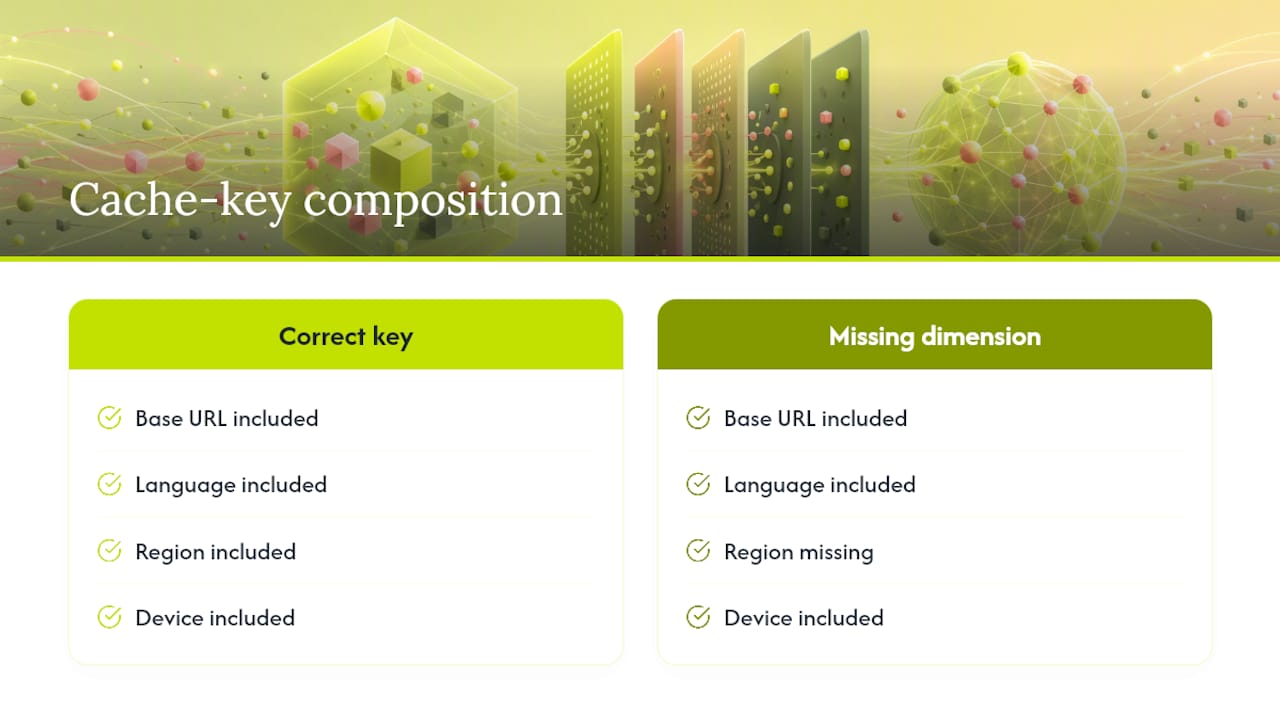
Cache key design is where most edge SEO implementations quietly break. Your CDN caches responses by a key, typically the URL by default, but the moment your worker starts varying output by language, region, device, or an A/B test bucket, that default key becomes wrong. If your cache key doesn’t include the dimension that changes the output, you’ll serve the French version to a visitor in Germany, or worse, serve a cached page from user A to user B. Akamai’s own EdgeWorkers documentation is explicit about this: any variant input used to change a response needs to be part of the cache key, or the response needs to bypass caching entirely. Add only the dimensions that legitimately produce different output. Adding every cookie or query parameter as a cache dimension causes what practitioners call cache cardinality explosion, where your CDN ends up caching thousands of near-identical variants and your hit ratio collapses.
For dynamic assembly, a common pattern is combining a lightweight HTML template with a JSON payload fetched at the edge, letting the worker stitch together a full page from cached fragments and live data without a full origin round-trip. That’s the pattern behind most edge-based personalization and localization setups today.
Where Edge SEO Actually Pays Off
Not every SEO fix belongs at the edge. The ones that do share a common trait: they’re blocked by something structural at origin, not by a lack of ideas.
- Redirect management. Legacy redirect chains, often three or four hops deep, get resolved into a single genuine 3xx at the edge, cutting both crawl waste and real user latency. This is frequently the single highest-impact edge SEO project for a site with years of accumulated URL changes.
- Hreflang management. Multi-region sites running on a CMS that can’t scale hreflang tags across dozens of locale combinations can have those tags generated and injected at the edge based on URL patterns, sidestepping a CMS limitation entirely.
- Crawl control via X-Robots-Tag. When origin templates can’t be touched, or when you need to block crawling on non-HTML assets like a PDF library or an image CDN, the header goes on at the edge instead.
- Structured data and meta tag injection. Legacy templates that were never built with schema markup in mind can have JSON-LD injected into the
headat the edge, without a CMS migration. - Prerendering for JavaScript-heavy sites. Serving a pre-rendered snapshot to bots while real users get the full client-rendered experience, handled entirely at the edge layer.
- A/B testing and temporary content changes. Edge workers make an ideal layer for testing title tag variations or meta description changes across a template family without deploying code twice.
- Log collection. When an origin platform doesn’t expose raw server logs (common on managed SaaS platforms and some headless CMSes), a worker can capture and forward request data for crawl analysis before it reaches origin.
Each of these solves a distinct problem, but they share the same underlying logic: the fix is available immediately at the edge, while the equivalent origin fix might sit in a backlog for a quarter or more.
How to Roll Out Edge SEO Changes Safely
Edge SEO earns its reputation for speed, but that same speed is exactly what makes a badly planned rollout dangerous. A worker script that misfires doesn’t wait for a staging review. It’s live, globally, the moment you deploy it. Treat every edge SEO project with the same rigor you’d apply to a production code deploy, because that’s precisely what it is.
- Define the response contract first. Before writing a single line of worker code, document exactly what the response should look like: status code, canonical tag, robots directive, structured data, and every header you intend to touch. This becomes your test spec.
- Validate parity between origin and edge output. Fetch the page as a normal browser user-agent and again as Googlebot, then diff the rendered HTML against what origin alone would produce. Any unintended divergence needs to be caught here, not in Search Console three weeks later.
- Design your cache keys deliberately. Include only the dimensions that genuinely change output, and set TTLs that match how often that underlying data actually changes. A page that varies by experiment ID needs the experiment ID in the cache key; a page that never varies by device shouldn’t have device type in the key at all.
- Roll out in stages. Pilot the change on a single region, a single template, or a single URL pattern before going global. Instrument cache-purge tooling and use versioned paths so you can roll back instantly if something breaks.
- Monitor the right KPIs continuously. Track cache hit ratio, origin request volume (it should drop as the cache absorbs traffic), rendered HTML parity between edge and origin, and Search Console coverage and indexing signals for the affected URL set.
- Sanitize everything you inject. Any user-derived or request-derived value that ends up in injected HTML needs to be escaped. An edge worker that reflects a query parameter into a meta tag without sanitizing it is a cross-site scripting vulnerability waiting to be found.
Pro Tip: Keep a versioned “kill switch” path in every worker deployment, a simple environment flag that reverts to pass-through behavior instantly. When something breaks at 2 a.m., you want a one-line rollback, not a redeploy.
Security deserves its own mention beyond sanitization. Because edge workers run before your origin’s own security layer sees the request, they’re also a natural place to enforce header hardening (Content-Security-Policy, Strict-Transport-Security) if origin doesn’t already. Just remember that responses tied to cookies or authentication state generally aren’t cached by default on platforms like Cloudflare Workers, which is correct behavior. Don’t fight it by forcing a cache on a personalized response.
What Edge SEO Won’t Fix
Edge SEO is a delivery layer improvement, not a content strategy. It can get your canonical tags right, cut your redirect chains, and shave milliseconds off TTFB globally, but it does nothing for pages that are thin, duplicative, or simply not what the query deserves. Practitioner analysis on edge computing and search is blunt about this limit: edge can reduce latency and improve availability, but it cannot manufacture relevance.
The other real risk is staleness. An incomplete cache invalidation after a content update means some regions or edge nodes keep serving the old version while others have the new one, creating inconsistent experiences that are hard to debug because they’re intermittent by nature. Serving materially different content to crawlers than to users is another trap. Any crawler-specific path should be treated as temporary technical debt with a monitoring plan attached, not a permanent architecture decision. And platform quirks bite: Workers’ Cache API doesn’t replicate identically across every edge location, and, as noted above, cookie-bearing responses typically skip the cache path entirely by default.
The Quicktoimpress Approach to Edge SEO Projects
Most edge SEO engagements start the same way: a template inventory. The process begins by mapping which page types exist, where the origin genuinely blocks a fix (a locked-down CMS, a vendor platform with no template access), and where the publish workflow itself is the bottleneck.
From there, the sequence is consistent: define the response contract, agree on cache rules with engineering, pilot the worker on a limited template or region, and test against both a standard user agent and a bot user agent before wide rollout. Monitoring follows the disciplines described above, including cache hit ratio, origin request volume, and Search Console coverage, tracked through the pilot and into full deployment.
This is engineering work as much as it is SEO strategy, which is why it sits inside Quicktoimpress’s broader growth platform capability rather than as an isolated audit. Multi-location brands and enterprise commerce sites, the organizations most often boxed in by legacy templates and slow release cycles, tend to see the clearest wins here.
When We Choose Edge Fixes Over Origin Changes
The threshold is simple: if origin engineering can ship the fix within a normal sprint, it usually belongs at origin, where it remains visible in version control long term. Edge earns its place when the constraint is structural, a vendor platform, a frozen legacy CMS, or a release process too slow for a time-sensitive fix.
Either way, involve engineering from day one. Worker scripts are production code and belong in the same repo review process as everything else, deployed like a feature flag with a clear rollback path. The mistake we see most often isn’t a bad rewrite rule. It’s nobody auditing which rules are still live six months later.
— Service
Get an Edge SEO Audit Built Around Your Stack
Most teams don’t need another generic technical SEO checklist. They need someone who can look at their actual CDN configuration, their actual CMS constraints, and tell them exactly which fixes belong at the edge versus which ones need an origin ticket. That’s the gap often filled by combining senior strategy paired with hands-on implementation, not a slide deck handed off to an internal team that’s already stretched thin.
For multi-location brands and enterprise commerce platforms carrying years of template debt, an edge SEO pilot is often the fastest way to prove impact before committing to a bigger platform overhaul. Quicktoimpress works with teams across B2B SaaS, multi-location brands, and enterprise commerce to run exactly this kind of engagement: discovery, response contract, staged rollout, and monitoring built in from the start. If your redirect chains, hreflang tags, or robots directives have been stuck behind an engineering queue for longer than you’d like to admit, start with a conversation about your growth platform and see where an edge pilot fits your roadmap.
Sources
For hands-on reference, consult Google’s robots meta tag and X-Robots-Tag documentation, Cloudflare’s HTMLRewriter API docs, and Akamai’s EdgeWorkers html-rewriter reference. To validate crawl rules before and after deployment, the BabyLoveGrowth robots.txt checker is a fast way to confirm directives resolve as intended.
- Robots meta tags | Google Search Central
- Html-rewriter & dynamic content assembly — Akamai EdgeWorkers
- What Edge Computing Can—and Cannot—Do for Search
FAQ
What Is Edge SEO?
Edge SEO means implementing SEO changes, like redirects, headers, and HTML fixes, at the CDN layer using serverless workers, so they go live without an origin code deployment.
Is Edge SEO Different from Regular Technical SEO?
Edge SEO is a delivery method for technical SEO changes, not a separate discipline. It solves the same problems (crawl control, redirects, structured data) but executes them at the network edge instead of in origin code.
Which Platforms Support Edge SEO Implementation?
Cloudflare Workers with its HTMLRewriter API and Akamai EdgeWorkers with its html-rewriter module are the two most established platforms for streaming HTML transformation and header control at the edge.
Does Edge SEO Hurt Page Speed?
No, when implemented correctly. Streaming rewriters like Cloudflare’s HTMLRewriter process HTML as tokens flow through rather than loading the full DOM, keeping time to first byte close to origin-only performance.
Can Edge SEO Replace the Need for Origin-Level Fixes?
No. Edge SEO handles delivery-layer problems like slow redirects or missing headers, but it cannot fix thin content, poor relevance, or structural site issues that require actual content or architecture changes.
How Does Quicktoimpress Approach an Edge SEO Project?
Quicktoimpress starts with template and constraint mapping, defines a response contract with engineering, pilots the change on a limited scope, and monitors cache and Search Console signals before full rollout.