Six Questions to Choose ETL or Reverse ETL: Data & RevOps Governance

ETL pulls raw data from operational systems into a warehouse where it gets cleaned and modeled for analysis. Reverse ETL takes that modeled data and pushes it back out to the CRMs, ad platforms, and support tools your teams actually work in. Use ETL when the consumer is a dashboard or an analyst; use reverse ETL when the consumer is a salesperson, a marketing campaign, or an automated workflow that needs to act on the insight.
TL;DR:
- Reverse ETL is best suited for real-time or hourly outbound data synchronization to operational tools used by sales, marketing, and customer success teams.
- Outbound transformations are lightweight, mainly reshaping modeled data into destination-specific formats, unlike the heavy logical processing done upstream in the warehouse.
- Proper schema mapping, idempotency, and monitoring are critical, as outbound data writes are more prone to issues due to API limits and potential damage to customer records.
- Initiate reverse ETL projects with low-risk, high-impact use cases like daily lead score updates or churn flags before scaling to real-time workflows.
- Effective governance requires environment separation, field-level permissions, data lineage, and detailed observability to prevent data discrepancies and safeguard customer data.
Table of Contents
- ETL vs Reverse ETL: A Quick Conceptual Comparison
- Why the Transformation Logic Is Completely Different
- The Architecture Behind Outbound Syncs
- Which Teams Actually Benefit From Each Approach
- Governance and Observability for Outbound Data
- How to Choose: A Practical Decision Checklist
- The Warehouse Is the Hub, Not Just a Reporting Layer
- What We’ve Learned Building Activation Pipelines for Clients
- Get Help Building Your Activation Pipeline
- Sources
ETL vs Reverse ETL: A Quick Conceptual Comparison
The two processes are mirror images of each other, and understanding the direction of data flow is the fastest way to keep them straight. ETL consolidates raw sources into the warehouse for analysis, while reverse ETL syncs the finished, modeled output back to the tools where people do their jobs.
Here’s the conceptual matrix broken down by function:
- Purpose: ETL prepares data for analysis; reverse ETL prepares data for action.
- Source and destination: ETL runs from operational databases, event streams, and third-party apps into the warehouse; reverse ETL runs from the warehouse into CRMs, ad platforms, and support desks.
- Consumers: ETL feeds analysts, data scientists, and BI dashboards; reverse ETL feeds sales reps, marketers, and automated systems.
- Cadence and latency: ETL commonly runs in nightly or hourly batches; reverse ETL ranges from hourly syncs down to near real time, depending on the use case.
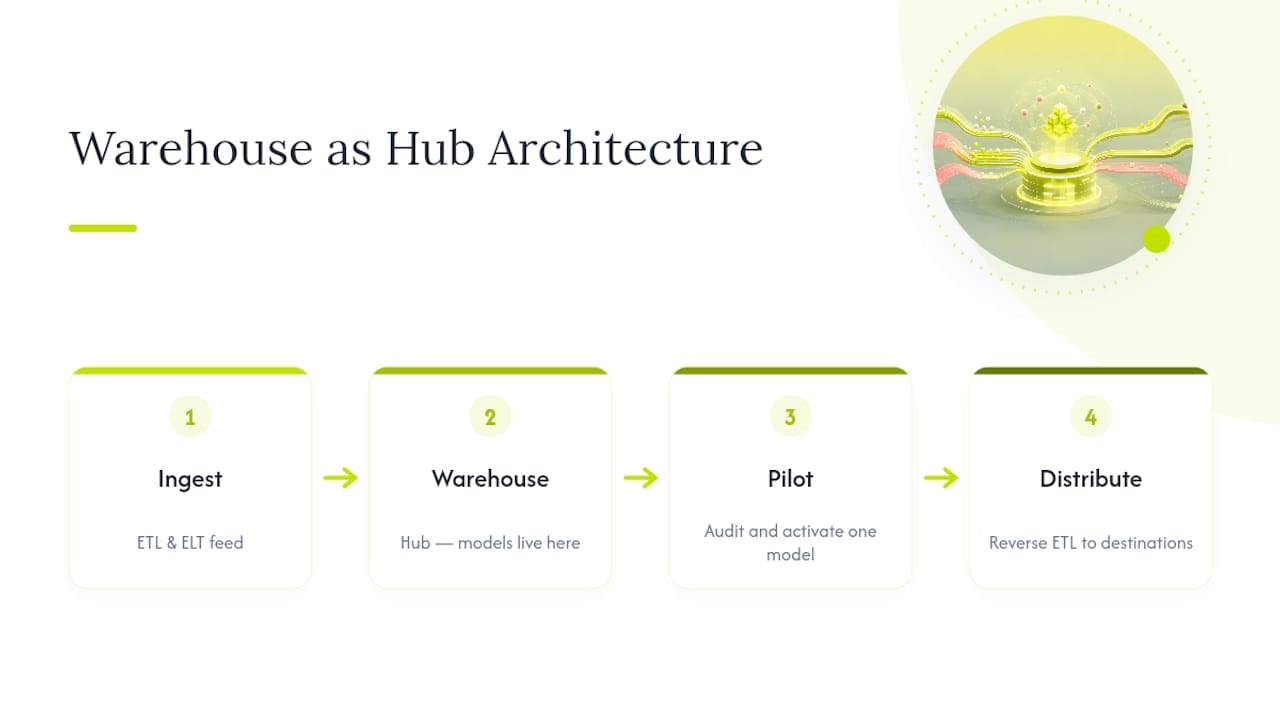
ELT, the more common modern variant, loads raw data first and transforms it inside the warehouse using tools like dbt. It sits upstream of reverse ETL in the same pipeline: ELT builds the models, and reverse ETL distributes them. Think of the warehouse as the hub in the middle, absorbing data on one side and radiating it back out on the other.
Why the Transformation Logic Is Completely Different
The transformations inside ETL and reverse ETL aren’t just different in size. They serve different jobs entirely, and mixing them up is one of the most common mistakes data teams make.
ETL and ELT transformations exist to make raw, messy data analyzable. That means deduplication, joins across multiple source systems, aggregations, and dimensional modeling designed to answer open-ended questions. A single customer table might get joined against orders, support tickets, and product usage events before it’s ready for a business analyst to query.
Reverse ETL transformations are lighter by design. Rather than rebuilding business logic, they take an already-modeled table, say, a customer health score, and reshape it to match the field names, data types, and formats a destination system expects. The heavy analytical lifting already happened upstream.
That distinction matters for how you organize your codebase:
- Keep core business logic in one place, typically in dbt-style analytical models with version control and automated tests.
- Build thin “export models” downstream of those core models, purpose-built for each destination’s schema.
- Never let a reverse ETL sync recompute logic that already lives in the warehouse. Duplicated logic drifts, and drift creates the kind of discrepancy that makes a sales rep distrust the number on their screen.
Pro Tip: Treat every export model like a small, versioned API. Document what each field means, write a test for it, and keep it under the same review process as your core models. That discipline is what makes a marketing manager trust the lead score showing up in their CRM.
The Architecture Behind Outbound Syncs
Loading data into a warehouse is comparatively forgiving. The warehouse is built to receive large volumes, and if something fails halfway through, you can usually just rerun the job. Writing data out to a third-party API is a different animal entirely, and it’s where most reverse ETL implementations run into trouble.
- Schema mapping is bespoke per destination. A “lifetime value” field in your warehouse might map to a custom field in one CRM and a completely different object in an ad platform, and each mapping has to be maintained separately.
- Idempotency and deduplication matter more outbound than inbound. Destination systems often lack the ability to roll back a bad write, so a sync that runs twice needs to produce the same result both times, not duplicate records.
- Rate limits and partial updates constrain design. Most operational APIs throttle how many requests you can send per minute, which forces batching strategies and careful sequencing rather than firehose-style syncing.
- Latency tradeoffs depend on the use case. Batch syncs (hourly or daily) suit lead scoring and reporting refreshes; near-real-time syncs suit churn alerts; in-session activation, like adjusting an on-site offer based on live behavior, needs infrastructure closer to a streaming pipeline than a scheduled job.
- Monitoring has to cover both ends. Retries, failure alerts, and cost tracking for API calls all need dedicated tooling, since a silent failure on an outbound sync doesn’t show up as an empty dashboard. It shows up as a rep working a stale lead list.
Which Teams Actually Benefit From Each Approach
The technical distinction only matters because it maps directly to who gets value from the data and when they get it.
ETL and ELT are the backbone of historical reporting, data consolidation across disconnected source systems, and cross-source analytics that answer “what happened” questions. Finance teams reconciling revenue across regions, analysts building cohort retention curves, and executives reviewing quarterly dashboards all depend on this layer.
Reverse ETL earns its keep on activation: getting a computed insight in front of someone who can act on it immediately. Common patterns include:
- Syncing customer lifetime value scores into a CRM so account managers can prioritize renewals.
- Building ad platform audiences from warehouse segments instead of relying on pixel-based retargeting alone.
- Pushing churn-risk flags into a customer success dashboard so CS reps see the warning before a renewal conversation, not after.
- Feeding lead-prioritization scores into a sales engagement tool so reps work the accounts most likely to convert first.
Cadence should follow the decision it supports. Daily syncs fit lifecycle scoring, hourly syncs fit lead routing, and near-real-time syncs fit anything tied to an in-product moment. In practice, data engineering usually owns the core models, while marketing or RevOps configures the destination mappings, with a clear handoff so nobody edits a model without the other side knowing.
Governance and Observability for Outbound Data
Writing modeled data into someone’s CRM or ad account carries more risk than loading data into your own warehouse, because a bad write can overwrite a real customer record that a rep is looking at right now.
- Field-level permissions and approvals should gate which models are eligible to sync outbound at all, not just who can query the warehouse.
- Environment separation (dev, stage, prod) prevents a half-finished export model from reaching a live CRM.
- Lineage mapping ties every destination field back to the warehouse model and test suite that produced it, so a marketer can ask “where did this number come from” and get a real answer.
- Sync observability, meaning SLAs, alerts, and audit logs, is what catches a failed batch before a sales team notices a stale field. Observability and sync verification function as the real operational differentiators between a reliable activation pipeline and a fragile one.
The number of destinations most companies now juggle makes this harder every year. The average number of SaaS applications used per company has climbed steadily, and every added tool is one more API with its own rate limits, schema quirks, and failure modes. Mitigating irreversible writes usually comes down to one practice: reconcile a snapshot of the destination’s current state against the warehouse before committing a write, rather than pushing changes blind.
How to Choose: A Practical Decision Checklist
Deciding between ETL and reverse ETL for a given need comes down to six questions: who consumes the output, how fast they need it, how much control the destination system requires, whether your team has the engineering capacity to maintain outbound connectors, what governance the data demands, and what it costs to run continuously.
- Identify the consumer. If it’s an analyst querying SQL, you need ETL. If it’s a rep, a campaign, or an automated workflow, you need reverse ETL.
- Map the latency requirement. Daily and hourly batches cover most CRM and ad-audience use cases; only in-session personalization justifies real-time infrastructure.
- Pick a single low-risk pilot. Start with a high-impact, low-frequency sync, like daily lead scores into a CRM, before attempting anything real-time.
- Build the export model with tests attached, not as an ad hoc query.
- Instrument observability from day one, including sync success rates and destination-side verification.
- Review after 30 days and decide whether to expand cadence, add destinations, or scale to more use cases.
Pro Tip: Pick a pilot where failure is cheap. A lead-scoring sync that runs a day late is an inconvenience. A pricing update that fires twice into a billing system is an incident.
The Warehouse Is the Hub, Not Just a Reporting Layer
Stop thinking of your warehouse as a place data goes to die in a dashboard. It’s a hub: ETL and ELT feed it, reverse ETL distributes what it learns, and the two processes are complementary, not competing. Most teams need both running at once. The next move is simple: audit where your best warehouse models are stuck behind a dashboard, and pick one to activate as a pilot.
What We’ve Learned Building Activation Pipelines for Clients
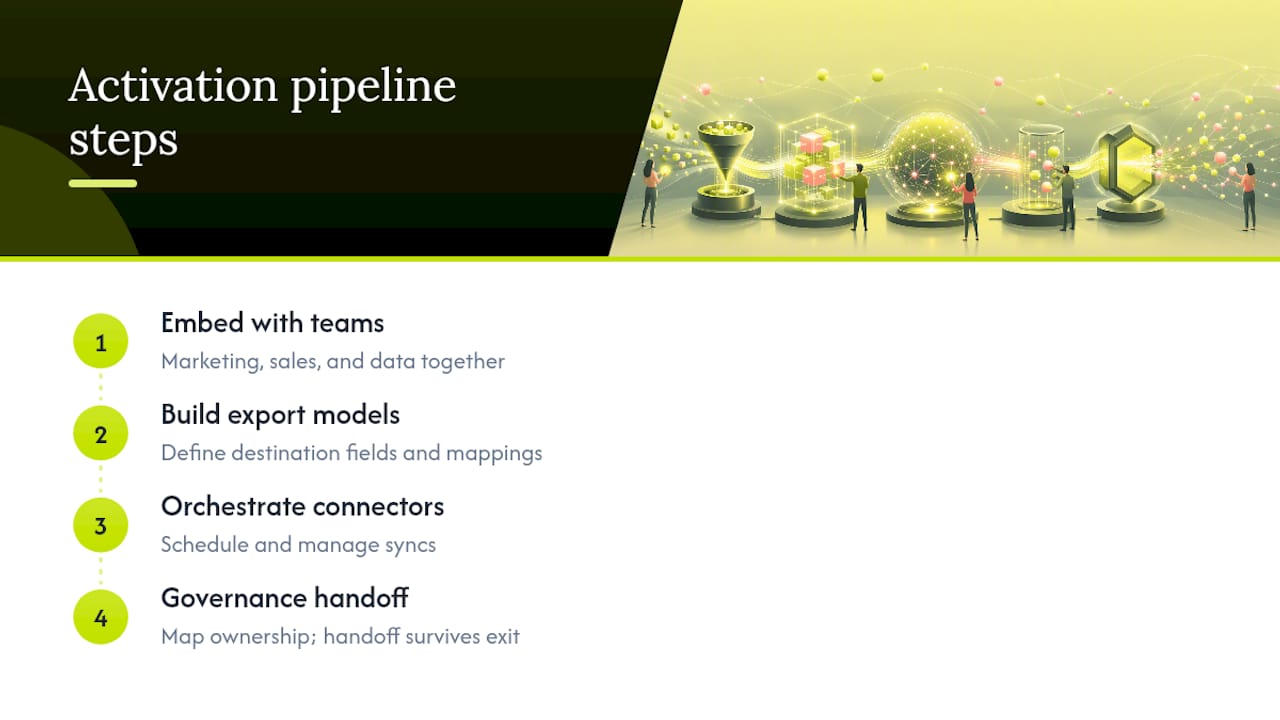
Most activation failures we see aren’t technical. They happen because nobody mapped which team owns the destination field before the sync went live. Our approach starts by embedding with marketing, sales, and data stakeholders together, then building export models, connector orchestration, and a governance handoff that survives after we leave.
— Service
Get Help Building Your Activation Pipeline
If reading this made you realize your warehouse has a dozen valuable models nobody outside data engineering ever sees, that gap is exactly what a growth engineering partner closes. Quicktoimpress designs the export models, connector orchestration, and governance layer so activation pipelines don’t depend on one engineer’s tribal knowledge to keep running.
This work sits inside our broader revenue operations practice, where we connect HubSpot, Salesforce, and marketing automation platforms directly to warehouse-modeled data instead of leaving teams to export CSVs by hand. It’s a natural extension of the growth platforms work we do for multi-location brands and B2B SaaS companies managing complex stacks, and it pairs well with guidance like this partner breakdown of scalable SaaS workflow design if you’re still mapping out the broader architecture. If your marketing, revenue, or technology team is stuck manually exporting warehouse data into operational tools, reach out to Quicktoimpress and we’ll scope a pilot together.
Sources
- What is Reverse ETL: Use Cases, Benefits, and Challenges | RudderStack
- What is Reverse ETL? The Definitive Guide | Hightouch
- Average number of SaaS apps used yearly | Statista