Franchisors: Governance First Franchise Marketing Systems in 60–90 Days

Franchise marketing systems combine a centralized CRM, permissioned local execution tools, and unified reporting so franchisors can run one customer record across every location. The measurable outcome to demand from any vendor or partner is simple: a customer 360 with location-level attribution, controlled local marketing rights, and revenue reporting that ties back to actual transactions. Get that right before shopping features, because integration and governance decide whether the system works at location 50 the same way it worked in the pilot.
TL;DR:
- A customer 360 view with hierarchical accounts and location-level attribution is critical for accurate reporting and decision-making in franchise marketing systems.
- Naming conventions, system ownership, and clear data governance are essential to prevent broken attribution and reduce long-term technical debt.
- Implementing a multi-week pilot with 5 to 15 locations helps validate integrations, performance, and governance before full deployment.
- Key KPIs include local customer acquisition costs, lead-to-sale rates, campaign ROI, and system utilization, with regular audits to maintain data quality.
- Prioritizing robust integration architecture over feature quantity ensures reliable attribution and saves costs compared to extensive feature shopping.
Table of Contents
- What Are the Core Components of Franchise Marketing Systems?
- Which Integrations Reduce Long-Term Technical Debt?
- How Should You Structure Governance and Permissions?
- How Do You Pilot a Franchise Marketing System in 60 to 90 Days?
- What KPIs Prove the System Is Working?
- Why Integration Discipline Beats Feature Shopping
- Where Quicktoimpress Fits When You’re Ready to Build
- Sources
- FAQ
What Are the Core Components of Franchise Marketing Systems?
A franchise marketing system really is five systems wearing one interface. Miss any one of them and the whole stack degrades into a glorified email tool.
Customer 360 and hierarchical accounts sit at the center. Every location needs its own view of its customers, but the franchisor needs to see the same person show up across three locations as one record, not three. Hierarchical account structures in the CRM make that possible.
Permissioned templates and local delivery give franchisees real marketing power without letting them go rogue. A local manager should be able to send a two-way SMS blast about a weekend promotion, edit the store name and hours, and hit publish, all inside guardrails the corporate team set.
POS and booking integration connects marketing spend to actual revenue and keeps royalty reconciliation honest. Without it, you’re guessing at ROI.
Local listings and reputation management protect search visibility store by store.
Centralized dashboards roll all of it up so the head office sees network performance without chasing spreadsheets from 40 different managers.
The ACHQ research on franchise marketing automation shows platforms built specifically for this model emphasize exactly these pieces: campaign control, local personalization, and consolidated reporting in one place, not five separate logins.
- Customer 360 with hierarchical accounts for franchisor and location-level views
- Permissioned templates for email, SMS, and social with local edit rights
- POS/booking/payment integration for attribution and royalty reconciliation
- Local listings, review monitoring, and location-level SEO controls
- Centralized dashboards with roll-up and drill-down reporting
Which Integrations Reduce Long-Term Technical Debt?
The system that looks clean in a demo often turns into a mess of broken syncs eighteen months later. That happens when nobody decided, upfront, which system owns which piece of data.
Start by naming an authoritative system of record for each data type: the CRM owns the customer record, the POS owns transactions, and the listings platform owns local presence data. Everything else references those systems rather than duplicating them.
For the connective tissue, most franchise networks land on one of three patterns: middleware platforms that centralize sync logic, event-driven architectures that push updates in real time, or API-first adapters paired with webhooks for lighter-weight connections. Heavier networks with high transaction volume tend to need the first two; smaller networks can often get by on webhooks alone.
- Assign one system of record per data type before connecting anything
- Choose middleware, event streams, or webhook-based adapters based on transaction volume
- Standardize campaign IDs and naming conventions before turning on automation
- Build lead routing rules with SLA timers and fallback assignment logic
Naming conventions matter more than most teams expect. Inconsistent campaign IDs are one of the most common, and most preventable, causes of broken attribution once a franchise network scales past a handful of locations, according to martech governance guidance from Martech360.
Pro Tip: Lock your campaign ID and naming taxonomy before you connect a single integration. Retrofitting naming standards after 20 locations are live costs far more than getting it right on location one.
Lead routing deserves its own line item. Without clear SLA rules and a fallback owner, two franchisees can end up fighting over the same lead, and that dispute usually lands on the franchisor’s desk.

How Should You Structure Governance and Permissions?
Most franchise marketing failures aren’t technology failures. They’re governance failures wearing a technology costume. The 2025 AFMR survey found 85% of franchise marketers say local marketing drives customer connection, yet 48% still leave local marketing entirely to franchisees with no central oversight. That gap is where inconsistent branding, duplicate spend, and broken attribution all live.
A Center of Excellence closes that gap by owning the standards, the integrations, and the system itself, while leaving room for local flexibility inside defined lanes.
- Define the CoE’s decision rights. Who owns platform selection, integration standards, and campaign template design? Put it in writing.
- Design permission tiers. Central admins control the core system; regional operators manage multi-location campaigns; store managers get edit rights inside templates; outside agencies get scoped, time-limited access.
- Build approval workflows. Local campaigns route through a lightweight review before publishing, especially for paid spend and email.
- Require audit trails. Every change, every send, every export needs a record. This isn’t optional once franchise agreements and data privacy obligations enter the picture.
A documented playbook and clear RACI for who approves what turns this from an ongoing argument into a repeatable process.
How Do You Pilot a Franchise Marketing System in 60 to 90 Days?
Skip the network-wide rollout. A pilot of 5 to 15 representative locations, mixing high performers, average performers, and at least one struggling location, tells you more in 60 days than a full launch tells you in six months, and that’s consistent with CRM implementation guidance for franchise networks.
- Weeks 1 to 2: Scope and schema. Pick pilot locations, finalize the customer 360 schema, and lock naming conventions.
- Weeks 3 to 5: Connect systems. Wire up CRM, POS, and listings integrations for pilot locations only.
- Weeks 6 to 7: Build permissioned templates. Get local teams working inside guardrails, not building from scratch.
- Weeks 8 to 10: Launch dashboards and train. Roll out reporting views and run hands-on training for pilot managers.
- Weeks 11 to 13: Measure and decide. Check data unification accuracy, local campaign performance, and SLA adherence on lead routing.
Pro Tip: Treat the pilot’s data export as a test in itself. If you can’t cleanly export customer and campaign data from the pilot, you have a governance problem that will only get worse at scale.
Security review matters just as much as feature testing. The AFMR research lists data privacy and security concerns among the top three hurdles to AI and martech adoption in multi-location networks, alongside integration complexity and a shortage of skilled staff to run the new stack.

What KPIs Prove the System Is Working?
Five numbers tell you whether the investment is paying off: customer acquisition cost by location, lead-to-sale conversion rate, customer lifetime value, local campaign ROI, and stack utilization (how much of the platform franchisees actually use versus ignore).
Roll-up dashboards belong on a monthly cadence for the franchisor’s leadership team. Location-level dashboards need weekly visibility for the people actually running campaigns day to day. Mixing those cadences up, monthly detail for local managers or weekly noise for executives, is a common reason systems get abandoned within a year.
Attribution hygiene is the quiet discipline behind all of it: consistent campaign IDs, disciplined UTM tagging, and clean POS-to-campaign mapping. Run a monthly audit for duplicate customer records, dead connector links, and data drift between systems. Catching a broken sync in week four is a five-minute fix. Catching it in month eight means reconstructing six months of attribution.
- CAC by location, tracked against local campaign spend
- Lead-to-sale rate and LTV by location and by cohort
- Local campaign ROI mapped through POS integration
- Stack utilization rate across franchisee users
- Monthly audit for duplicates, dead connectors, and data drift
Why Integration Discipline Beats Feature Shopping
Most franchisors evaluate marketing systems by feature list first and integration architecture second. That order is backward. A platform with fewer features but a clean data model will outperform a feature-rich system with brittle connectors within a year, because attribution and reporting break silently, and nobody notices until quarterly numbers don’t reconcile.
The accountable-partner model works because the people who design the data schema and permission structure also build the integrations and stay through the pilot. Quicktoimpress is a growth engineering partner for scaling companies, embedding with marketing, revenue, and technology teams to build the connected systems behind sustainable growth, rather than handing a strategy deck to a separate execution team and hoping the translation holds.
That continuity matters most in the messy middle of a rollout, when a POS integration behaves differently at location 12 than it did in the pilot, or when a franchisee pushes back on permission scope. Fixing those problems fast, with the same team that designed the system, is what actually compresses time to value.
— Service
Where Quicktoimpress Fits When You’re Ready to Build
Some firms provide an alternative to hiring a traditional agency and a separate systems integrator for franchise marketing infrastructure by offering one accountable team that handles the strategy and hands-on build, from CRM architecture through the integrations that make attribution actually work.
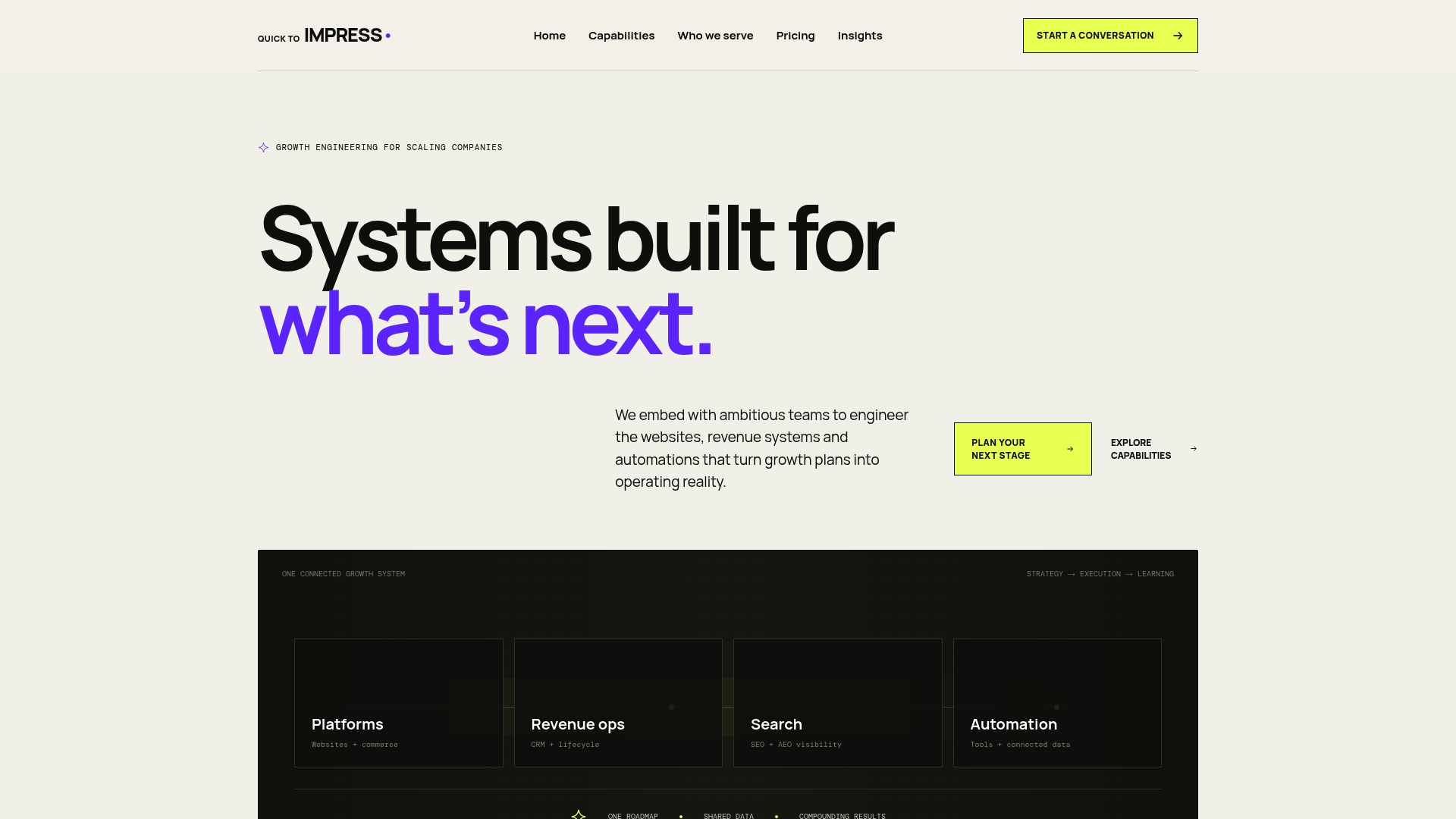
For franchisors, that typically means growth platform work to unify the customer-facing side, revenue operations engineering to connect CRM, POS, and reporting into one data flow, and AI search and automation work once the governance foundation is solid. The engagement path mirrors the pilot roadmap above: a scoped pilot, a measured rollout, then ongoing refinement as the network grows.
Engagements start at $3,500 a month at the Core capacity tier, scaling up through Growth and Scale capacity as integration complexity and location count grow. If your team is evaluating a rebuild or a first real system, the capabilities page and multi-location brands page are the fastest way to see whether the fit is right, and to start that conversation.
Sources
Franchise marketing leaders evaluating a system should also review the 2025 AFMR findings on local marketing and AI adoption hurdles, the multi-location marketing playbook on governance structure, and the franchise CRM implementation guide for a practical feature checklist. AI governance specifics for multi-location brands are covered in Silvermine’s data governance framework. For platforms extending into AI-driven content production, Baby Love Growth’s AI content marketing resources offer additional context on scaling personalized content across locations.
FAQ
What Is a Franchise Marketing System?
It’s a combined CRM, local marketing automation, and reporting platform that gives a franchisor centralized control while letting franchisees run permissioned local campaigns. The goal is one customer record and consistent attribution across every location, backed by CRM implementation guidance built for franchise networks.
How Long Should a Pilot Run Before Full Rollout?
Most franchise networks should run a pilot for 60 to 90 days across 5 to 15 representative locations before expanding further. That window is enough time to validate data integration, local campaign performance, and lead-routing SLAs without committing the whole network to an unproven system.
Who Should Own Local Marketing, the Franchisor or the Franchisee?
Neither side should own it exclusively. Franchisors should own the platform, standards, and templates, while franchisees get permissioned control over local execution like send timing and store-specific copy. That split addresses a real gap: 48% of franchise marketers currently leave local marketing entirely to franchisees with no central oversight, which tends to produce inconsistent branding and untracked spend.
What Does It Cost to Build a Franchise Marketing System With a Partner?
Costs vary widely by scope and location count, but Quicktoimpress structures engagements starting at $3,500 per month at the Core capacity tier, with Growth and Scale tiers priced higher for larger, more complex rollouts.
What’s the Biggest Technical Risk in a Franchise Marketing Rollout?
Integration failure and inconsistent naming conventions cause more damage than any missing feature. System-wide integration complexity, a shortage of skilled staff, and data privacy concerns rank as the top three adoption hurdles multi-location brands report when rolling out martech and AI tools.