Engineers: 4 Growth Engineering Projects That Move Metrics

Growth engineering is the practice of writing and instrumenting code specifically to move a small set of business metrics: acquisition, activation, retention, and monetization. The goal is not shipping features for their own sake but shipping changes that produce a measurable lift in a number the business cares about. Engineers, engineering managers, and technical leaders evaluating this discipline should expect it to look and feel like software engineering with a scoreboard attached.
TL;DR:
- Growth engineering requires a combination of frontend, backend, and data skills, with SQL and experimentation platforms being foundational to effective measurement.
- Building reliable instrumentation, feature flags, and metric pipelines is essential for meaningful experiments that deliver actionable insights.
- An experiment lifecycle includes forming hypotheses, proper measurement, running statistically powered tests, and tracking cohort retention to avoid false positives.
- The organizational structure should evolve from embedded teams to dedicated or platform teams as size and complexity grow, ensuring accountability for funnel metrics.
- Delivering measurable business outcomes, like increasing activation or monetization, depends on precise mapping of code changes to specific metrics and mechanisms.
Table of Contents
- What Is Growth Engineering, Exactly?
- What Growth Engineers Actually Build Day to Day
- The Skills and Tools Growth Engineers Actually Use
- How to Run Experiments Without Fooling Yourself
- Choosing the Right Org Model for Your Growth Function
- Connecting Engineering Work to Revenue and Retention
- Building a CV That Actually Shows Growth Impact
- How Quicktoimpress Builds This Capability for Clients
- Where AI Agents Fit Into the Growth Engineer’s Job
- When to Bring In Quicktoimpress for Growth Engineering
- Sources
- FAQ
What Is Growth Engineering, Exactly?
Growth engineering is the discipline of writing code to help a company grow by moving metrics such as acquisition, activation, retention, and monetization. That definition sounds simple, but the boundaries around it get blurry fast, especially for engineers coming from a traditional product background.
Product engineering builds and maintains the core experience: the features customers came for, the architecture that keeps the product stable, the roadmap tied to long-term vision. Growth marketing runs campaigns, writes copy, and buys media, largely operating outside the codebase. Growth engineering sits between them, but it is still engineering. It owns:
- Instrumented experiments that live inside the product, not just in ad platforms
- Funnel changes (signup flows, pricing pages, onboarding) shipped with measurement built in from day one
- Feature-flagging infrastructure that lets the team test safely at scale
- Metric pipelines that turn raw events into decisions
Growth engineers collaborate with marketers on messaging and with product managers on prioritization, but they write the code themselves. That kills the “hacky code” myth that follows this discipline around. The best growth engineering teams are obsessive about measurement rigor, data governance, and code quality, because a badly instrumented experiment produces a confident, wrong answer. Speed matters, but speed without integrity just generates noise dressed up as insight.
What Growth Engineers Actually Build Day to Day
Ask ten growth engineers what they worked on last month and you’ll get ten different answers, but they cluster into four buckets. Growth engineers commonly own experiments, onboarding flows, billing and pricing tests, and platform work that tie engineering changes directly to revenue or funnel metrics.
- Acquisition and activation. This is landing page variants, signup flow rewrites, SEO instrumentation (structured data, page speed fixes that affect crawl and conversion), and referral loop mechanics. A growth engineer might rebuild a three-step signup form into one step and instrument every field abandonment to find where users bail.
- Retention and product-led growth. Onboarding checklists, in-product prompts that nudge a user toward their “aha moment,” personalization logic that changes what a new user sees based on their signup source or stated goal.
- Experimentation and rollout infrastructure. Feature flags, holdout groups, and progressive rollouts that let a team ship to 5% of traffic, watch the numbers, and expand or kill the change without a full deploy cycle.
- Platform and automation work. ETL pipelines that move product event data into a warehouse, lifecycle automation (win-back emails triggered by behavior, not calendar dates), and API integrations connecting the product to billing, CRM, or analytics tools.
Some high-velocity teams run hundreds of these experiments in a single year, combining rapid shipping with statistical guardrails and a meta-analysis process that turns each test into a reusable learning rather than a one-off win. That volume only works because the platform work in bucket four exists first. Without reliable instrumentation and flagging infrastructure, bucket one through three collapse into guesswork with extra steps.
The Skills and Tools Growth Engineers Actually Use
Hiring managers looking for a growth engineer, and engineers trying to break into the role, both ask the same question: what do I actually need to know? The honest answer spans four categories, and most job postings only test one or two of them.
- Core engineering: frontend changes (React, Vue, whatever the product stack runs), backend hooks for feature evaluation, API work, and enough infrastructure knowledge to stand up feature flags without breaking production.
- Data fluency: SQL is non-negotiable. Growth engineers query warehouses directly, build small metric libraries, and check data integrity before trusting a dashboard. If you can’t write a window function to compute retention cohorts, you’ll spend your career waiting on a data analyst.
- Experimentation tooling: platforms like GrowthBook, PostHog, Mixpanel, Amplitude, and warehouses like BigQuery show up constantly. GrowthBook in particular pushes toward warehouse-native analysis and transparent statistical engines, including approaches like CUPED and sequential testing that reduce how long an experiment needs to run.
- Soft skills that don’t show up on a syllabus: writing a falsifiable hypothesis, explaining a metric tradeoff to a skeptical VP, and negotiating scope with a product manager who wants the change shipped without the two extra weeks of instrumentation.
Pro Tip: If you’re learning this stack from scratch, start with SQL and one experimentation platform before touching feature-flag infrastructure. Most growth engineering failures trace back to bad metric definitions, not bad code.
A growth engineer who can write clean React but can’t read a p-value is only half built. The reverse, a data-fluent engineer who can’t ship a frontend change without three days of back-and-forth, is just as limited.
How to Run Experiments Without Fooling Yourself
Every growth experiment follows the same lifecycle: form a hypothesis, pick one primary metric, instrument it correctly, run the test, then make a call. Skipping any step is how teams end up shipping changes based on noise.
Statistical rigor is where most self-taught growth engineers get burned. A test needs enough statistical power to detect the effect size you’re hoping for, run long enough to cover a full business cycle (weekday and weekend behavior differ), and be segmented by cohort so a win in one user segment doesn’t get diluted or exaggerated by an unrelated segment. Sequential testing methods help teams peek at results early without inflating false positive rates, which matters when a product manager wants an answer after three days instead of three weeks.
Not every change needs a formal A/B test. A risk-based rubric works well here: low-risk UI tweaks with small blast radius can ship with simple before-and-after measurement, while revenue-facing or high-risk changes need a powered, randomized experiment or a holdout group.
- Small copy change on a low-traffic page: ship and watch.
- Pricing page restructure: full A/B test with a pre-registered primary metric.
- New onboarding flow for all new signups: staged rollout with holdout, minimum two to four weeks.
Teams that scale this well don’t treat each experiment as disposable. They build an experiment library, track win rate and lift distribution over time, and treat past results as inputs to the next hypothesis instead of starting from zero every quarter.
Choosing the Right Org Model for Your Growth Function
There’s no single correct structure for growth engineering, and the right answer changes with company size. Three models cover most companies:
- Embedded model. Growth engineers sit inside existing product squads, picking up growth-tagged tickets alongside regular feature work. This works for smaller teams but growth work tends to lose priority the moment a deadline crunch hits.
- Dedicated growth team. A standalone team with its own engineers, a PM, and sometimes a designer, focused entirely on funnel metrics. This is the most common model once a company has product-market fit and needs someone accountable for the numbers full time.
- Growth platform team. At larger scale, the team shifts from running experiments itself to building the infrastructure (flagging systems, experimentation frameworks, metric pipelines) that lets every product team run its own experiments safely.
The signal that you need to move from embedded to dedicated is usually operational: growth ideas keep losing to feature deadlines, or nobody owns the funnel metrics when they slip. The role itself changes shape with that shift, too. Early-stage companies need generalists who can run an experiment end to end, from writing the frontend change to querying the results. Larger organizations need specialists, someone owning acquisition funnels, someone else owning the experimentation platform, someone else owning statistical rigor across the whole org.
Connecting Engineering Work to Revenue and Retention
The gap between shipping code and moving a business metric is where growth engineering earns its keep, and it’s also where teams most often fool themselves. Every technical change should map to a specific metric with a specific expected mechanism, not a vague hope that “this will help growth.”
- Rebuilding a signup flow to reduce time-to-first-value directly targets activation, and typically shows up as a shift in day-one or day-seven retention.
- A pricing page experiment testing annual versus monthly framing targets monetization, showing up in ARPU or conversion-to-paid rate.
- An in-product referral prompt targets acquisition, showing up in a new signup source and a lower blended customer acquisition cost.
Not every early win holds up. Growth hacking loops that emphasize quick hypothesis-test-learn cycles need durability checks, cohort analysis and retention tracking, to confirm a spike in signups isn’t just pulling forward users who would have converted anyway, or attracting low-intent users who churn within a week. A metric that jumps and then decays isn’t a win; it’s a preview of a worse number next month.
Picking the right north-star metric matters more than picking more metrics. A team chasing signups alone will happily ship changes that hurt activation. A team anchored to a metric like “activated accounts per week” has a built-in check against vanity wins.

Building a CV That Actually Shows Growth Impact
Growth engineering resumes fail for a predictable reason: they list technologies instead of outcomes. The formula that works is simple: what you built, why it worked, and the measurable outcome.
- Instead of “Built onboarding flow using React and feature flags,” write “Rebuilt onboarding to surface the core feature in step one instead of step three, lifting day-seven activation by reducing time-to-first-value.”
- Interviews increasingly include a take-home or live task: design an experiment for a given funnel drop-off, or critique a flawed test setup and identify the statistical error.
- When exact numbers are confidential, describe the relative change (percentage lift, rank among tested variants) and the mechanism, rather than omitting impact entirely.
Frame your experience by company stage, too. A generalist story fits an early-stage pitch; a platform-ownership story fits a role at a larger company where specialization is expected.
How Quicktoimpress Builds This Capability for Clients
This company operates as a growth engineering partner for scaling companies, combining senior strategy with hands-on execution rather than handing a roadmap to a separate delivery team. The people shaping the plan stay involved building it.
- Delivers growth platforms, website and commerce engineering, revenue operations, technical SEO, internal tools, and workflow automation
- Full scope of work is outlined on the capabilities page
- Works with multi-location brands, B2B SaaS companies, and enterprise commerce organizations managing complex technology stacks
- Structured as one accountable partner rather than a bucket of disconnected hours
Where AI Agents Fit Into the Growth Engineer’s Job
AI agents now write experiment code, generate analysis scripts, and draft variant copy faster than a person can type. That speed doesn’t reduce the value of the human role, it concentrates it. The differentiator shifts to agent direction: framing the right hypothesis, defining the correct metric, and catching a spurious result before it ships. Teams adapting well are building metric governance and guardrails into their tooling now, not after an agent ships a confident, wrong conclusion.
— Service
When to Bring In Quicktoimpress for Growth Engineering
Hiring one growth engineer solves a narrow problem. Partnering with Quicktoimpress solves the harder one: getting the platform, instrumentation, and revenue operations built at the same time, by people who stay accountable through delivery instead of disappearing after the strategy deck.
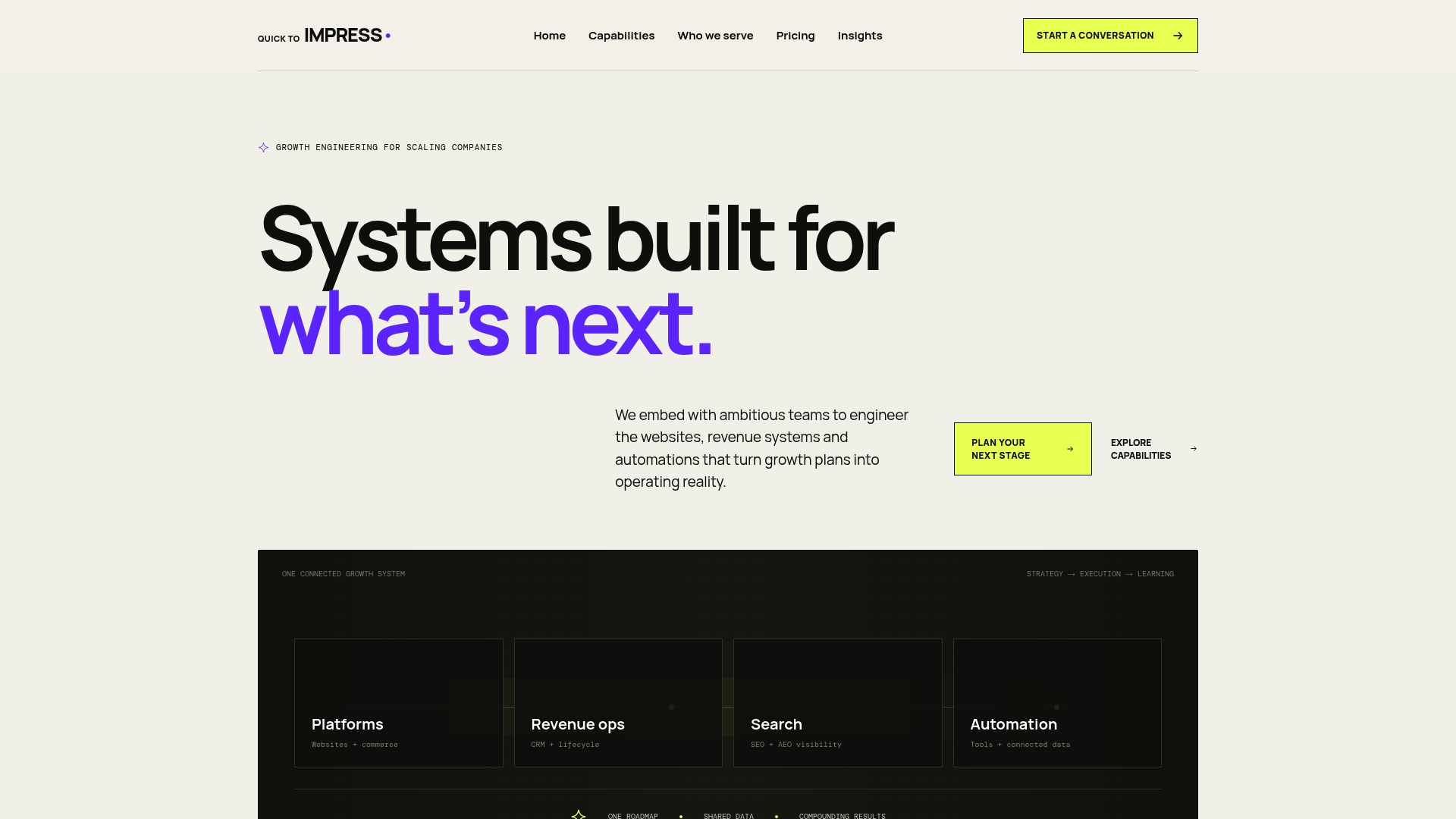
Quicktoimpress is structured around three engagement tiers built for exactly this handoff point. Core capacity runs $3,500 to $5,999 a month, Growth capacity runs $6,000 to $9,999 a month, and Scale capacity starts from $10,000 a month for organizations running multiple platforms or brands at once. If you’re staffing a single embedded growth engineer, that’s a hiring decision. If you need experimentation infrastructure, revenue operations, and a technical SEO layer built and maintained together, that’s a partnership decision, and it’s the gap Quicktoimpress is built to fill. Review the pricing tiers or the full capabilities list to see which scope matches where your team is right now.
Sources
For deeper technical grounding, The Pragmatic Engineer’s breakdown of growth engineering and PostHog’s explainer on the growth engineer role are strong starting points. For data-driven tactics, Baby Love Growth’s guide to using data for growth insights covers practical measurement approaches worth comparing against your own metric setup.
- What is Growth Engineering? — The Pragmatic Engineer
- What is a growth engineer? (And why they’re awesome) — PostHog
- The AI native growth team — Growth Unhinged
- Growth Engineer CV Guide — NextCV
FAQ
What Does a Growth Engineer Do?
A growth engineer writes and ships code aimed directly at business metrics like signups, activation, retention, or revenue, rather than general product features. Typical projects include onboarding flows, pricing tests, and experimentation infrastructure tied to a specific funnel metric.
How Much Do Growth Engineers Make?
Compensation varies widely by company stage, location, and whether the role is generalist or platform-focused, and no verified figure applies across the market. Candidates should check current listings for their region and stage rather than rely on a single number.
What Are the Top Types of Engineering Roles Related to Growth?
The three most common are growth engineers (embedded in funnel and experimentation work), platform or infrastructure engineers (building the flagging and metrics systems growth teams rely on), and data engineers (maintaining the pipelines that make metrics trustworthy). Larger companies often split these into distinct roles, while smaller ones expect one person to cover all three.
Is 40 Too Late to Move Into Growth Engineering?
No. Growth engineering rewards SQL fluency, product judgment, and experiment design skills that senior engineers from other disciplines often already have. The transition usually means learning one experimentation platform and reframing existing project experience using the built plus mechanism plus outcome format rather than starting a technical career over.
How Is Growth Engineering Different From Growth Hacking?
Growth hacking usually refers to fast, informal tactics, while growth engineering applies engineering discipline, instrumentation, and statistical rigor to the same goal. Durability checks like cohort analysis distinguish a real win from a temporary spike that decays once the novelty wears off.