Get Cited on ChatGPT in 90 Days: For Mid and Large Marketing Teams

Ranking in ChatGPT means your brand gets mentioned or cited accurately when someone asks a question in your category, not that you hold a numbered slot. The fastest move is technical: ship a 40 to 80 word extractable answer on your key pages, wrap it in Article and FAQPage JSON-LD, and confirm Bing and OAI-SearchBot can actually crawl the page. Everything past that splits into two tracks: fast retrieval fixes that show results in weeks, and slower training-corpus authority work that takes months to compound.
TL;DR:
- Technical fixes such as publishing extractable answers and FAQ schema help ensure your pages are accessible for ChatGPT retrieval within weeks.
- Building a consistent entity profile across multiple platforms and publishing original research reinforce long-term recognition as a credible source.
- Structuring content with answer-focused sections, named authors, and unique data significantly increases the chances of your content being cited by ChatGPT.
- Ensuring crawlability by checking robots.txt, serving server-rendered content, and maintaining stable URLs are critical before investing in marketing efforts.
- A coordinated, fast-following technical audit prevents citation stagnation and supports authority-building strategies over a timeline of several months.
Table of Contents
- What Does It Take to Rank in ChatGPT Right Now?
- How Do You Make a Page Extractable at Query Time?
- What Builds Long-Term Authority in ChatGPT’s Training Data?
- Which Content Patterns Actually Get Cited?
- What’s the Engineering Checklist Before Any of This Works?
- How Do You Measure ChatGPT Citation Share?
- What Does a 90-Day Rollout Actually Look Like?
- Who Actually Implements a Program Like This?
- What Actually Moves the Needle Here?
- Ready to Build Both Tracks at Once?
- Sources
What Does It Take to Rank in ChatGPT Right Now?
Treat this as a prioritized checklist, not a wish list. Every item below maps to a real owner and a real time-to-effect, because the biggest mistake teams make is treating a two week technical fix and a six month press campaign as the same kind of work.
- Fast wins (days to two weeks): confirm Bing Webmaster indexing, publish an
llms.txtfile, add FAQ JSON-LD to your top 20 pages, write extractable 40 to 80 word answer blocks, and add visible “last updated” dates. Owner: engineering plus content, working together. - Medium-term (four to eight weeks): build structured comparison pages, publish original survey data or usage statistics, and pitch two or three targeted mentions in trade publications your buyers already read. Owner: content and comms.
- Long-term (two to six months): get your entity profile clean on Wikipedia and Wikidata if you qualify, secure press coverage and analyst reports, and keep your
sameAsgraph consistent across every platform. Owner: comms and SEO leadership.
The fast track builds momentum you can show leadership in a single sprint review. The long track is what keeps you cited a year from now, according to a 2026 ChatGPT ranking playbook that separates these two mechanics explicitly.
How Do You Make a Page Extractable at Query Time?
ChatGPT’s browsing mode retrieves live pages, and it favors content it can lift cleanly without interpretation. That means the structure of the page matters as much as the quality of the writing underneath it.
Write the answer before you write the explanation. Every H2 or H3 that could plausibly match a user’s question needs a 40 to 80 word answer directly beneath it, phrased the way you’d say it out loud to a colleague who asked the question directly. Save the nuance, caveats, and examples for the paragraphs that follow.
A few implementation rules matter more than the rest:
- Match your FAQPage schema “name” field to the exact visible question text on the page. Mismatched schema and visible copy is one of the most common reasons FAQ markup gets ignored.
- Publish an
llms.txtfile at your root domain listing canonical URLs for your most important pages. It’s a lightweight signal that tells retrieval systems where your authoritative content lives, and allowing OAI-SearchBot to crawl those pages is what actually lets the citation happen. - Add a visible “updated” date and a short changelog note (“Updated pricing table, March 2026”) near the top of any page you expect to be cited for time-sensitive queries. Pages with recent update dates and visible changelogs are consistently more likely to get pulled into retrieval-based answers.
- Use tables for anything comparative. Tables are easier for a model to extract cleanly than a paragraph making the same comparison in prose.
Pro Tip: Write your extractable answer as if you’re dictating it to someone who will only read that one sentence. If it doesn’t stand alone, it won’t get lifted cleanly.
What Builds Long-Term Authority in ChatGPT’s Training Data?
Retrieval gets you cited this week. Training-corpus presence is what determines whether a model already “knows” your brand as a credible source before it ever browses a live page, and that’s a slower, more relationship-driven game.
Start with identity consistency. Your company name, one-line description, and category classification should read identically across your About page, LinkedIn company profile, Crunchbase listing, and Wikidata entry if you have one. Models build entity understanding from overlapping signals across sources, and a description that says “growth engineering partner” in one place and “digital agency” in another muddies that signal.
From there, invest in three areas:
- Pitch original research, industry benchmark reports, and guest bylines to the trade publications your buyers actually read. Original data gets cited and re-cited, which is exactly the kind of repetition that reinforces training-time authority.
- Participate genuinely in Reddit threads and domain-specific forums where your category is already being discussed. This isn’t about dropping links. It’s about being a real, named, credible voice in the threads that get scraped and referenced.
- Track where your brand already gets mentioned by third parties and fix the gaps. If competitors show up in five industry roundups and you show up in zero, that’s a comms priority, not a content one.
None of this moves fast. Budget it in quarters, not sprints.
Which Content Patterns Actually Get Cited?
The pages ChatGPT cites share a structure, and it’s not complicated. Start every major section with a direct answer sentence, then back it with specifics.
Comparisons and named authors are two of the highest-leverage tactics. Named author bylines with real credentials, paired with Organization schema, give models a clearer signal about who’s accountable for the claim being made. Formatting patterns like answer-first structure, named authors, and original data show up consistently across the pages that get pulled into ChatGPT’s answers.
Original statistics are especially powerful because they make your page the canonical source. Adding unique numbers to a page has been shown to lift AI visibility by roughly 30 to 40% in practitioner tests, because a model has nowhere else to attribute that specific figure once it exists on your page first.
Here’s how retrieval-friendly formatting compares to standard blog formatting:
| Content pattern | Standard blog format | Retrieval-optimized format |
|---|---|---|
| Answer placement | Buried after intro and history | First sentence under the heading |
| Data presentation | Described in prose | Presented in a table with labeled columns |
| Author attribution | Generic byline or none | Named author with stated credentials |
| Freshness signal | No visible date | Visible “updated” date and changelog |
| Comparative claims | Vague (“better”, “faster”) | Specific numbers with named source |
Original statistics don’t just support your argument. They make your page the source other answers point back to, which is a different kind of citation than simply being one of several pages mentioned.
What’s the Engineering Checklist Before Any of This Works?
None of the content work matters if the crawler can’t reach the page. This is where most technical audits find the real blocker.
- Confirm your
robots.txtdoesn’t block OAI-SearchBot or Bingbot. Check this before anything else. It’s the single most common reason a well-optimized page never gets cited. - Publish and validate your
llms.txtfile so canonical URLs are explicit rather than inferred. - Serve extractable answer blocks in server-rendered HTML. If your key content only appears after client-side JavaScript executes, a lot of crawlers will simply miss it.
- Keep canonical URLs stable. Redirects, parameter variants, and duplicate paths for the same content fragment your authority across multiple URLs instead of consolidating it.
- Return clean 200 status codes on the pages you want cited, and test with a schema validator to confirm your Article and FAQPage markup actually parses.
Pro Tip: Run your top 20 pages through a schema validator and a rendering test in the same afternoon. Teams almost always find at least one page where the JSON-LD is broken and nobody noticed because the page still looks fine to a human visitor.
Bing indexing deserves its own line item here because it’s easy to assume Google indexing covers it. It doesn’t. Confirming Bing Webmaster indexing and allowing retrieval crawlers is a distinct, gating step that needs its own audit.
How Do You Measure ChatGPT Citation Share?
Standard analytics fail here. ChatGPT strips referrer headers, so GA4 typically logs that traffic as Direct or unattributed, which means you need a different measurement approach entirely.
- Build a canonical set of 30 to 50 real buyer queries, the exact phrasing your prospects would type, and run them against ChatGPT weekly to track whether and how you’re cited.
- Use purpose-built AI-visibility tools alongside the AI-tracking features now built into platforms like Ahrefs and Semrush, and pair them with server-side attribution to connect citations to actual pipeline.
- Track sentiment and factual accuracy in each mention, not just whether you appeared. A citation that misstates your pricing or positioning is worse than no citation at all.
- Log which specific page or paragraph got cited so content teams know which formats are working.
Set this up before you scale the tactics above. Otherwise you’re optimizing blind for months before anyone can prove the work paid off.
What Does a 90-Day Rollout Actually Look Like?
Sequence matters more than intensity. Front-load the audit, then split delivery between the fast and slow tracks.
- Sprint 0 (week 1): audit indexation status, current citation gaps against competitors,
llms.txtpresence, robots.txt permissions, and schema mismatches across your top pages. - Weeks 1 to 4: ship extractable answer blocks and FAQ JSON-LD on priority pages, fix any crawl blockers found in the audit, and confirm Bing indexing is live.
- Months 2 to 3: launch outreach for targeted third-party mentions, publish at least one original data piece, and start iterating on your measurement dashboard based on early citation results.
Expect first citations on fixed technical issues within two to four weeks. Expect authority-driven citations, the ones tied to press mentions and entity clarity, to take a full quarter or longer before you see a measurable shift.
Who Actually Implements a Program Like This?
Most in-house teams have the strategy but not the combined engineering and content execution bandwidth to run both tracks at once. Quicktoimpress operates as an embedded growth engineering partner rather than a disconnected project vendor, which matters here because schema rollouts, llms.txt deployment, and measurement pipelines all cross the same engineering and content boundary that slows most internal teams down.
The mapping is direct: technical schema and crawler audits fall under Quicktoimpress’s capabilities in SEO and answer-engine optimization, entity graph and identity consistency work overlaps with revenue operations and CRM data hygiene, and the measurement pipeline connecting citations to pipeline runs through the same attribution systems built for multi-location brands and enterprise commerce teams managing complex stacks. The team stays hands-on through delivery rather than handing a strategy deck to another vendor.
What Actually Moves the Needle Here?
Most of the advice circulating about ranking in ChatGPT treats it like a single algorithm to reverse-engineer. It isn’t. It’s two systems on distinct timelines, and the teams that get frustrated are almost always the ones trying to run a long-term authority play as if it should produce results quickly.
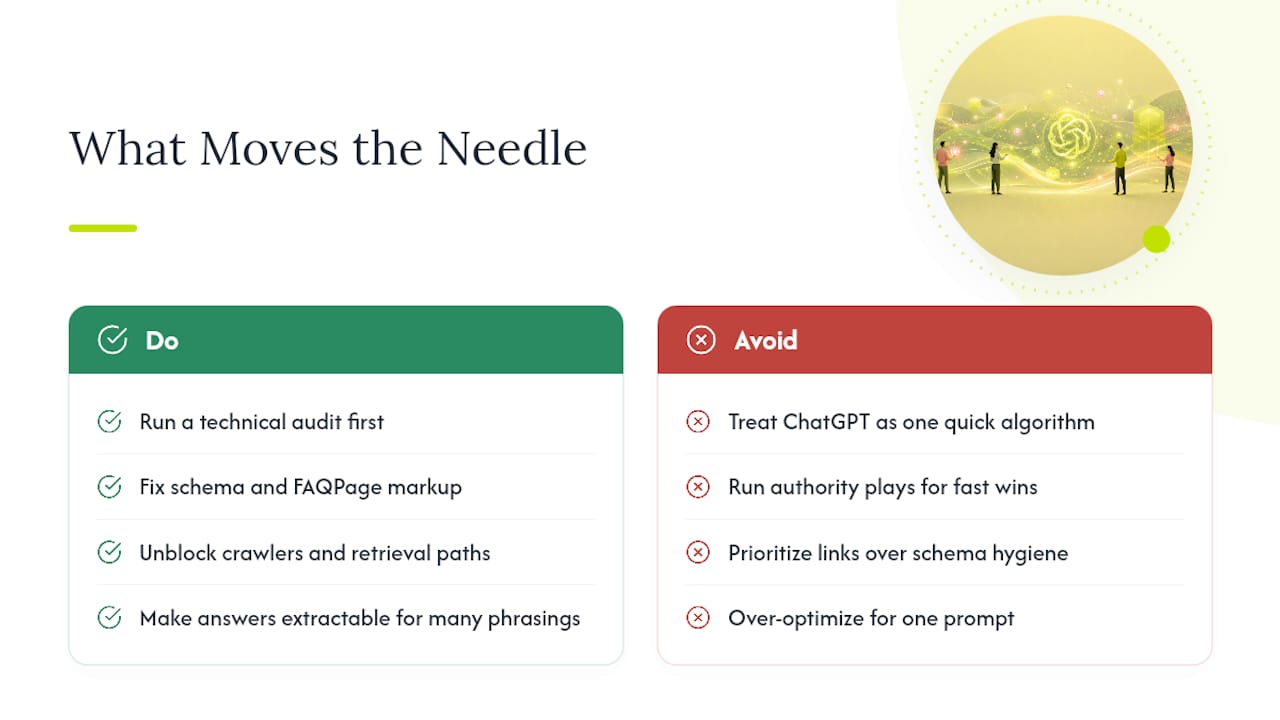
The conventional wisdom overweights link building and underweights schema hygiene. A broken FAQPage markup or a blocked crawler will kill your citation odds regardless of how many press mentions you’ve earned, and that’s a fixable engineering problem most SEO teams don’t check first. Prompt engineering matters far less than most vendors claim; you can’t control the exact phrasing a buyer types into ChatGPT, so optimizing for one hypothetical prompt wastes effort that should go toward making the answer extractable for dozens of phrasings at once.
Start with the audit, not the campaign. Fix what’s blocking retrieval before you invest a single dollar in press outreach or original research. The fast track funds the case for the slow one, and skipping straight to authority building without fixing the technical layer underneath it is the single most common reason programs stall in month two.
— Service
Ready to Build Both Tracks at Once?
An alternative to hiring separate specialists is to have one team handle FAQ JSON-LD rollout, llms.txt deployment, entity graph cleanup, and citation-tracking dashboard as a connected build rather than disconnected handoffs.
That matters because the two-track approach above only works when engineering and content ship in the same sprint instead of waiting on each other’s timelines. A growth engineering model that keeps senior strategists involved throughout the build helps ensure the roadmap in week one is executed by the same team later. Coordinating across multiple locations, complex CRM systems, or enterprise commerce platforms can lead to delays in many in-house efforts.
Start with a conversation about where your current setup blocks retrieval today. Visit Quicktoimpress to scope a starter engagement or a full audit of your ChatGPT visibility gaps.
Sources
Validate your schema with a JSON-LD testing tool before publishing, and check Bing Webmaster Tools directly rather than assuming Google indexing covers it. The PMC study on ChatGPT citation accuracy is worth reading if you want the underlying data on hallucination rates across model versions, and APA’s citation guidance is a useful reference for how retrievable versus non-retrievable outputs get treated in formal citation contexts.
- How to Rank in ChatGPT (2026 Playbook) | Attrifast
- How to Rank in ChatGPT: A Step-by-Step Guide — AI Search Insider
- How to Rank in ChatGPT: Step-by-Step Guide (2026) | Layer3Labs