90 Day RevOps Framework to Fix B2B Alignment and Forecasting

A RevOps framework is a company-wide operating system that aligns people, process, technology, and data to produce predictable revenue. Its core payoff is simple: less friction between marketing, sales, and customer success, and a forecast leadership can actually trust. The best frameworks organize around four connected pillars, People, Process, Technology, and Data, with Metrics and Cadence layered on top to keep the whole thing accountable.
TL;DR:
- A strong RevOps framework improves forecast accuracy and pipeline velocity when pipeline stages, deal definitions, and handoff criteria are standardized across teams.
- Building a framework involves a structured 90-day process starting with an operational audit, followed by defining shared SLAs, quick wins, and a detailed roadmap for systematic improvements.
- Effective metrics include pipeline velocity, win rate, net revenue retention, forecast accuracy, data completeness, SLA compliance, and automation coverage, reviewed regularly at weekly, monthly, and quarterly cadences.
- Failures occur mainly from technology-driven attempts to fix misaligned processes without first establishing clear data, definitions, and SLAs, emphasizing the importance of sequencing the build.
- Successful adoption depends on involving stakeholders in design, consistent communication, and aligning incentives to reinforce the new operating principles over multiple review cycles.
Table of Contents
- What Business Outcomes Come From a Strong RevOps Framework?
- Which RevOps Framework Should You Actually Use?
- How Do You Actually Build a RevOps Framework?
- Which Metrics Should a RevOps Framework Track?
- What Makes RevOps Frameworks Fail?
- What Should Be in Your RevOps Deliverable Checklist?
- Who Owns What: Aligning Sales, Marketing, and Customer Success
- How Do You Integrate the Systems Behind a RevOps Framework?
- How Do You Get Teams to Actually Adopt a New RevOps Framework?
- What Does a Successful RevOps Rollout Actually Look Like?
- Why Systems Thinking Beats Org Charts Every Time
- How Quicktoimpress Builds RevOps Frameworks That Ship, Not Just Diagrams
- Where To Go Deeper on RevOps Frameworks
- Sources
- FAQ
What Business Outcomes Come From a Strong RevOps Framework?
The payoff of a working RevOps framework shows up first in forecasting. When pipeline stages, deal definitions, and handoff criteria mean the same thing across teams, forecast variance drops because everyone is measuring the same thing the same way. That consistency is what separates a forecast leadership trusts from one it double checks every quarter.
Pipeline velocity is the second lever. A framework that documents lead routing, qualification criteria, and SLA response times removes the dead time between a lead entering the funnel and a rep acting on it. Practitioner guides tracking RevOps frameworks that drive growth and alignment report measurable gains in forecasting accuracy and pipeline velocity specifically when data governance and a regular review cadence are in place, not just when new software gets installed.
Industry signal: Companies that build structured customer feedback loops into their revenue process have linked those programs to 20 to 40% revenue growth in practitioner case studies, underscoring how much upside sits in the “listen and act” layer most RevOps builds skip.
The operational efficiency case is just as strong. Consider what changes when a framework is actually in place:
- Reps stop re-entering the same data across three systems because integrations handle the sync.
- Marketing and sales stop arguing about what counts as a “qualified lead” because the definition is documented and shared.
- Renewals and expansion get flagged automatically instead of surfacing only when a customer already looks unhappy.
- Leadership gets one number for pipeline coverage instead of three conflicting spreadsheets.
None of that requires exotic technology. It requires agreement, documentation, and a system that enforces the agreement once it’s made. That’s the entire argument for building a framework instead of hoping alignment happens organically.
Which RevOps Framework Should You Actually Use?
Most guidance out there presents three models as if you have to pick one. In practice, they describe the same territory from different angles, and the strongest RevOps strategy borrows from all three depending on what stage you’re diagnosing.
The four-pillar model is the one most practitioners reach for first: People, Process, Technology, and Data. It’s a structural map. People covers roles and reporting lines. Process covers the documented steps a deal or ticket follows. Technology covers the stack that executes those steps. Data covers the information flowing through all of it. This model is easy to explain to executives, which is exactly why it dominates internal decks.
The four-layer model, described in detail by Fairview’s revenue operations framework, sequences build order rather than just naming components: Data, then Process, then Metrics, then Cadence. The sequencing matters more than the naming. Fairview’s own guidance is blunt about why: start with data because automating a broken process just breaks it faster, and building metrics on unreliable data manufactures false confidence. Process comes second because it depends on trustworthy inputs. Metrics come third because they measure the process you just built. Cadence comes last because it’s the discipline that turns metrics into decisions.
The Six Pillars model, developed through Myndwrks research, is different in kind. It names structure, nature of work, drivers, audience, resources, and outcomes, and it’s built to be used as a diagnostic coordinate system rather than a maturity ladder you climb in order. You score your organization against each pillar independently. Practitioners frequently discover the biggest gaps sit in “resources” (enablement, training, playbooks) and “outcomes” (customer experience), two dimensions the four-pillar model doesn’t name explicitly at all.
Here’s how they map to each other in practice:
- People (4-pillar) roughly overlaps with Structure and Resources (Six Pillars).
- Technology (4-pillar) overlaps with the tooling half of Process (4-layer).
- Data (4-layer) is the same Data described in the 4-pillar model, just sequenced first instead of listed third.
- Metrics and Cadence (4-layer) correspond to Drivers and Outcomes (Six Pillars).
Forrester’s operating-model research makes the point that matters most across all three models: design the operating principles and decision rules first, not just an org chart. A framework is a set of agreements about how decisions get made, not a diagram of who reports to whom.
How Do You Actually Build a RevOps Framework?
Building or refreshing a RevOps framework works best as a timeboxed sprint, not an open-ended project. Here’s the sequence that practitioner playbooks converge on, adapted into a 90-day structure.
- Weeks 1 to 2: Run the operational audit. Map every tool touching revenue, every handoff between marketing, sales, and customer success, and every place data moves between systems. The deliverable is a spreadsheet, not a slide: list each tool, each process step, each handoff owner, and where data currently breaks or duplicates.
- Weeks 2 to 4: Build the alignment artifacts. This is where shared definitions get written down for the first time: what counts as a qualified lead, what “closed won” means across systems, and a documented lifecycle map showing how a prospect moves from first touch to renewal. SLAs between marketing and sales, and between sales and customer success, get written and signed off here, not assumed.
- Month 2 to 3: Ship quick wins. CRM hygiene (deduping records, standardizing fields), automated lead routing based on the criteria defined in step two, and one consolidated pipeline report that replaces the three conflicting spreadsheets everyone’s been arguing over. This is where the framework earns credibility, because it’s the first thing stakeholders can actually see change.
- Days 60 to 90: Build the roadmap. Prioritize the next wave of work against the pillars: a Technology fix (an integration that stops manual re-entry), a Process fix (a documented escalation path for stalled deals), a Data fix (a validation rule that stops bad entries at the source). SyncGTM’s implementation playbook frames this as the point where a unified lifecycle map, an SLA matrix, a prioritized roadmap with named owners, and a first data-quality dashboard should all exist as concrete artifacts, not intentions.
- End of quarter: Run the retrospective. Revisit the metrics defined during the audit, reset targets based on what the first 90 days actually revealed, and feed findings into the next planning cycle.
Pro Tip: Sequence the quick wins so the first one is visible to executives within 30 days. A consolidated pipeline report that finally agrees with itself does more to build trust in the framework than a perfect data model nobody outside RevOps ever sees.
The 90-day sprint structure isn’t arbitrary. It matches how long it takes to move from diagnosis to a working roadmap without losing organizational patience, and it gives you a natural checkpoint to decide what gets built next.
Which Metrics Should a RevOps Framework Track?
A framework without metrics is just documentation. The metrics that matter split into two categories: shared revenue KPIs that marketing, sales, and customer success all watch together, and operational KPIs that measure whether the framework itself is functioning.
Shared revenue KPIs:
- Pipeline velocity: (number of qualified opportunities × average deal value × win rate) ÷ average sales cycle length. This tells you how fast revenue is actually moving, not just how much is sitting in the pipeline.
- Win rate: closed won deals ÷ total qualified opportunities. Track it by segment, not just in aggregate, because a healthy blended number often hides one segment that’s badly underperforming.
- Net revenue retention: (starting recurring revenue + expansion, minus contraction and churn) ÷ starting recurring revenue. This is the single number that tells you whether growth is durable or borrowed from next quarter.
- Forecast accuracy: predicted revenue versus actual closed revenue, measured as a percentage variance each period.
Operational KPIs:
- Data completeness: percentage of required CRM fields populated correctly at each pipeline stage.
- SLA compliance: percentage of handoffs (lead to rep, deal to onboarding) completed within the documented time window.
- Automation coverage: percentage of manual, repeatable tasks that have been automated versus still handled by hand.
Cadence is what turns these numbers into decisions instead of dashboards nobody opens. A weekly rhythm should cover pipeline health and at-risk deals, the kind of review that catches a stalling deal before it becomes a missed quarter. A monthly rhythm should widen to a full-funnel review: conversion rates at each stage, plus an audit of whether documented processes are actually being followed. A quarterly rhythm is the framework retrospective: reset targets, revisit the metric definitions themselves, and feed findings directly into the next planning cycle.
Practitioner data tying customer feedback programs to 20 to 40% revenue growth makes a strong case for adding a customer-experience metric to the monthly agenda, not just leaving it to an annual survey.
What Makes RevOps Frameworks Fail?
Most RevOps frameworks fail for the same handful of reasons, and none of them involve a lack of ambition.
Buying tools before defining process is the most common trap. A new platform gets purchased to “fix alignment,” and six months later the same misalignment exists inside a more expensive system. Fairview’s sequencing guidance exists precisely because of this pattern: fix data and process first, then let technology execute what’s already been agreed on.
Hiring a RevOps title without an operating plan produces the same result. One person gets the job title, no documented operating principles exist, and that person spends a year mediating disputes between departments instead of building the system that would prevent them.
Undocumented SLAs and weak data governance compound quietly. When “the marketing team will hand off qualified leads quickly” isn’t written down anywhere with a specific time window and specific criteria, disputes about whose fault a stalled deal is become a monthly occurrence.
A short remediation checklist for teams already in this position:
- Write down every SLA that currently exists only as a verbal agreement.
- Audit CRM field completeness before adding any new automation.
- Assign one named owner per pillar, People, Process, Technology, Data, so gaps have an accountable owner instead of diffusing across departments.
- Revisit the Six Pillars diagnostic quarterly to catch drift in resources and outcomes specifically, since those two are the ones teams consistently under invest in.
Pro Tip: If you can’t name who owns your lead routing SLA in under ten seconds, you don’t have a framework yet. You have a set of habits that happen to be working, for now.
What Should Be in Your RevOps Deliverable Checklist?
A RevOps framework only becomes real once it exists as artifacts someone can open, not just a philosophy the team agrees with in a meeting. The core deliverable set:
- An operational audit spreadsheet documenting every tool, handoff, and data flow touching revenue.
- A unified lifecycle map showing exactly how a prospect moves from first touch through renewal.
- An SLA matrix defining response times and ownership across every cross-team handoff.
- A data-quality dashboard tracking completeness and accuracy at each pipeline stage.
A typical embedded engagement pairs a strategist who designs the framework with an execution team that actually builds the integrations, dashboards, and automations, running the 90-day audit-to-roadmap sprint described earlier as a single accountable unit rather than a strategy phase followed by a separate implementation vendor.
| Deliverable | What it answers | Owner type |
|---|---|---|
| Operational audit | Where is data breaking or duplicating today? | RevOps lead |
| Lifecycle map | What does “qualified,” “handoff,” and “closed” mean company wide? | Cross-functional |
| SLA matrix | Who owes whom a response, and by when? | Department heads |
| Data-quality dashboard | Is the framework’s foundation reliable enough to automate? | RevOps + IT/ops |
[Client case studies demonstrating measurable RevOps outcomes and named client testimonials will be added here as engagement results become available.]
Who Owns What: Aligning Sales, Marketing, and Customer Success
A framework only holds if responsibilities are explicit, not implied. Marketing typically owns everything up to a qualified lead handoff: campaign performance, lead scoring criteria, and the definition of what “qualified” means before a record ever reaches a rep. Sales owns the pipeline from that handoff through closed deal: qualification depth, forecast accuracy on their own book, and adherence to the SLA marketing was promised in return.
Customer success owns the relationship from onboarding through renewal and expansion, which means it needs visibility into the deal that was sold, not just the account after the fact. This is where a surprising number of frameworks quietly break: sales closes a deal with terms customer success never sees documented, and the first onboarding call becomes a negotiation instead of a kickoff.
The fix isn’t a reorganization. It’s a documented RAI structure, Responsible, Accountable, Informed, applied to each stage of the lifecycle map built during implementation. Each function needs one named owner per stage, and each owner needs visibility into the stage before and after their own. RevOps itself usually sits above all three as the function that owns the connective tissue: the data model, the reporting layer, and the SLA enforcement, without owning quota or renewal targets directly. That distinction matters because RevOps loses credibility fast if it’s seen as grading the same teams it’s supposed to be serving.

How Do You Integrate the Systems Behind a RevOps Framework?
Integration strategy should follow the data-first sequencing already established: fix what data means and where it lives before connecting more systems to move it faster. A CRM (commonly HubSpot or Salesforce) sits at the center as the system of record, with marketing automation, customer success platforms, and billing systems syncing into it rather than each maintaining a separate version of the customer.
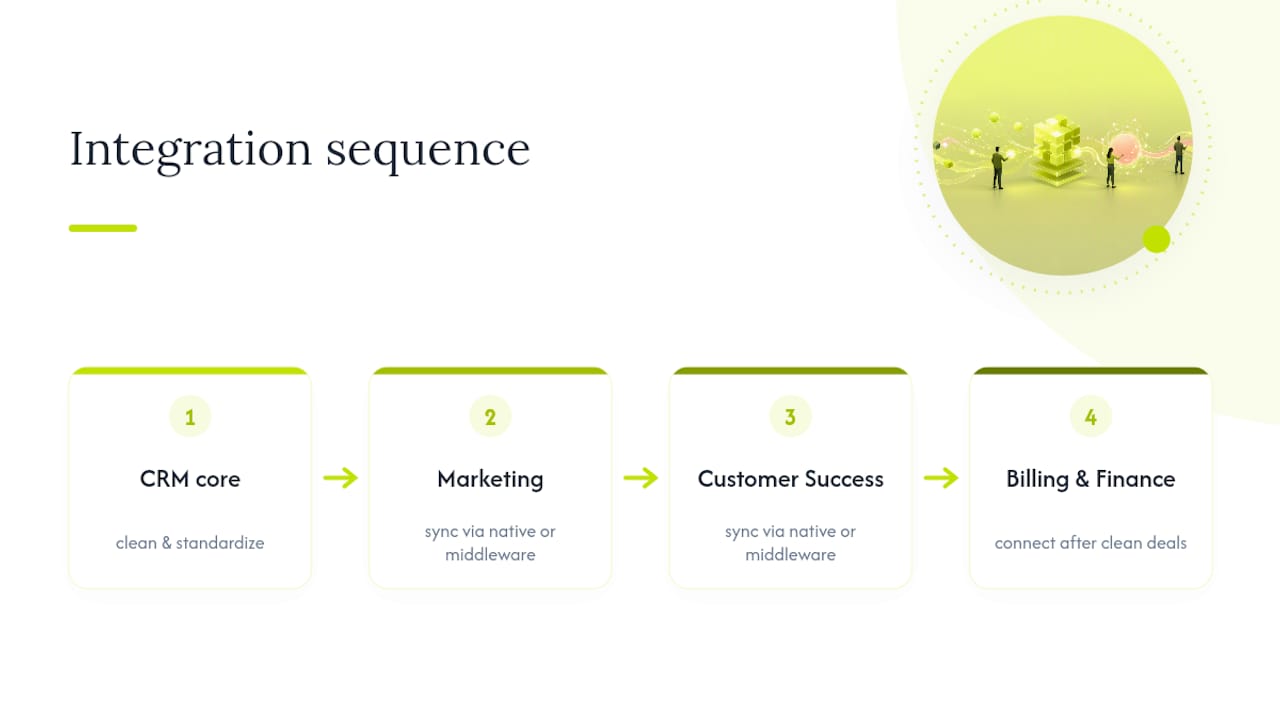
The practical priority order looks like this. First, get the CRM’s core objects (contacts, companies, deals) clean and standardized, since every downstream integration inherits whatever mess already exists there. Second, connect marketing automation so lead scoring and campaign attribution flow into the same record sales sees, eliminating the “which number is real” argument between departments. Third, connect the customer success platform so account health, product usage, and renewal risk are visible without a separate login. Billing and finance systems come last in most builds, not because they matter less, but because they depend on clean deal data existing first.
Middleware and native integrations both have a place. Native integrations are more reliable for high-volume, standard objects. Middleware earns its cost when you’re connecting a system with no native integration or need custom field mapping logic that a point-to-point connection can’t handle. Either way, integration is an execution problem, not a strategy problem, best handled by whoever is already responsible for maintaining the technical capabilities behind the framework.
How Do You Get Teams to Actually Adopt a New RevOps Framework?
Change management is where most of the technically sound frameworks quietly die. A perfectly designed lifecycle map that sales never uses is worse than no map at all, because it creates a false sense that alignment exists.
The pattern that works starts with naming a stakeholder from each affected function, marketing, sales, customer success, during the audit phase, not after the roadmap is built. People adopt systems they helped design far more readily than systems handed to them finished. The quick wins built in weeks two through four aren’t just credibility builders for leadership, they’re the proof point that convinces frontline reps the framework makes their job easier instead of adding another reporting requirement.
Communication cadence matters as much as the change itself. A framework rollout announced once in an all hands meeting is functionally the same as no rollout. Reinforcing new SLAs and definitions in the weekly pipeline review, repeatedly, for the first two quarters, is what actually shifts behavior. Forrester’s operating-model guidance frames this as designing decision rules people actually use day to day, not policies that live in a shared drive nobody opens.
The last piece is incentive alignment. If sales compensation still rewards behavior the new SLA discourages, no amount of communication will fix adoption. Change management for a RevOps framework is ultimately an incentive design problem wearing a training program’s clothes.
What Does a Successful RevOps Rollout Actually Look Like?
The clearest real-world pattern across successful RevOps rollouts isn’t a specific tool stack. It’s sequencing discipline: audit before automation, shared definitions before dashboards, and a named owner before a new process gets enforced.
Companies that report the improved forecasting and pipeline velocity gains documented in practitioner research tend to share a specific pattern: they treated the first 90 days as a diagnostic and quick-win sprint, not a full system rebuild. They fixed CRM hygiene and lead routing before touching forecasting models, because a forecast built on bad data just produces a confident wrong answer faster.
The failure pattern is just as instructive by contrast. Organizations that jump straight to enterprise tooling without first agreeing on shared definitions typically end up automating the disagreement itself, routing leads faster to a definition of “qualified” that two departments still don’t agree on. The technology performs exactly as designed. The underlying misalignment just moves faster.
[Additional case study detail specific to Quick To Impress client engagements will be added here as results become publicly shareable.]
Why Systems Thinking Beats Org Charts Every Time
The conventional advice on RevOps treats it as a hiring decision: get a RevOps title on the team and alignment follows. That’s backwards. A title without a documented operating plan just gives misalignment a new person to blame.
What actually works is treating RevOps as systems engineering: data first, process second, metrics and cadence third, exactly the sequencing Fairview’s framework argues for, because each layer depends on the one beneath it being trustworthy. Skip that order and you’re automating garbage or measuring noise.
The honest signal that it’s time to bring in outside execution capacity isn’t when things are broken. It’s when the audit and roadmap are done, everyone agrees on the plan, and the internal team still doesn’t have the bandwidth to build the integrations and dashboards that plan requires. That gap between a good plan and built infrastructure is where most frameworks stall for a year or more.
— Service
How Quicktoimpress Builds RevOps Frameworks That Ship, Not Just Diagrams
Most RevOps engagements split strategy and execution across two vendors, which means the people who designed your lifecycle map never touch the integration that’s supposed to enforce it. Quicktoimpress runs both under one accountable team: the strategist who audits your funnel and writes your SLA matrix is the same person overseeing the HubSpot, Salesforce, and integration work that makes it real.
That structure matters most in the exact 90 day window this article walks through: audit, alignment artifacts, quick wins, roadmap. A revenue operations engagement with Quicktoimpress follows that same sequence, backed by the technical capacity to actually ship the CRM cleanup, lead routing, and consolidated reporting most internal teams plan for but never finish building. Engagements start at Core capacity, running $3,500 to $5,999 per month, with Growth and Scale capacity available as the roadmap expands. If your framework is already designed and you need the execution capacity to build it, check current engagement shapes and pricing to see what fits your roadmap.
Where To Go Deeper on RevOps Frameworks
For readers who want the original research behind the models covered here:
- Forrester’s operating-model framework for designing operating principles, not just org charts.
- Myndwrks’ Six Pillars research for a diagnostic view beyond structure.
- Fairview’s four-layer guide for sequencing data, process, metrics, and cadence.
- SyncGTM’s implementation playbook for audit-to-roadmap deliverables.
- Highspot’s RevOps benefits research for forecasting and velocity outcomes.
Sources
- The Forrester High-Performance Operating Model Framework For Revenue Operations
- The Six Foundational Pillars of RevOps (Myndwrks research)
- The Revenue Operations Framework: A Complete Guide (Fairview)
- The RevOps frameworks that drive growth and alignment (Highspot)
FAQ
What Does RevOps Actually Do?
RevOps designs and maintains the operating system connecting marketing, sales, and customer success: shared definitions, documented handoffs, integrated systems, and the metrics and cadence that turn data into decisions. It owns the connective tissue between revenue teams rather than owning quota or renewal targets directly.
What Is RevOps vs DevOps?
RevOps focuses on aligning people, process, technology, and data across revenue generating teams to produce predictable growth. DevOps is a software engineering discipline focused on the pipeline between writing code and shipping it reliably; the two share a systems mindset but operate in entirely different functions.
What Are the Core Elements of a RevOps Strategy?
A RevOps strategy centers on four connected pillars: People, Process, Technology, and Data, sequenced so data and process are solid before technology automates them, per Fairview’s four-layer model. Metrics and a regular review cadence sit on top to keep the whole system accountable.
What Is Included in a RevOps Framework?
A complete RevOps framework includes documented role ownership across sales, marketing, and customer success, an integrated technology stack, governed data, shared KPIs, and a cadence of weekly, monthly, and quarterly reviews. Practical builds also include a lifecycle map, an SLA matrix, and a data-quality dashboard as concrete artifacts.
How Much Does It Cost to Get Help Implementing a RevOps Framework?
Pricing depends on scope and how much execution capacity a team needs beyond strategy. Quicktoimpress structures engagements starting with Core capacity at $3,500 to $5,999 per month, scaling up to Growth and Scale capacity for larger implementation workloads.