Risk Focused System Integration Testing for QA: Map 3 Journeys

System integration testing (SIT) checks that separately built components, once wired together, actually pass data and behave correctly as one system, not just as isolated parts. It runs after unit tests confirm individual code works and before user acceptance testing checks the business signs off. The real payoff is catching seam failures, broken handoffs between services, mismatched data formats, timing issues, before they reach production and become customer-facing incidents.
TL;DR:
- Run SIT against critical business journeys with high blast radius and frequent changes to ensure system seams are correctly integrated before release.
- Prioritize SIT at the merge and pre-release stages, with clear criteria requiring documented waivers for failures to prevent risky releases.
- Use contract testing tools like Pact for microservices to verify APIs without deploying both ends continuously, reducing cost and complexity.
- Automate and stabilize SIT environments with ephemeral containers, service virtualization, and tiered test execution to improve reliability and speed.
- Focus on mapping seams and ownership early, including evidence collection, to turn SIT into a meaningful risk control rather than just a coverage checklist.
Table of Contents
- What System Integration Testing Actually Covers
- When to Run SIT and What Justifies the Investment
- Integration Testing Strategies: Top-Down, Bottom-Up, and Beyond
- Building a Practical Integration Test Plan and Checklist
- Making SIT Reliable: Environments, CI/CD, and Automation Patterns
- Integration Testing Tools Mapped to Real Scenarios
- Common Challenges in Integration Testing and How to Fix Them
- How Quicktoimpress Builds SIT Into Growth Engineering Work
- The Case for Treating SIT as Risk Control, Not a Coverage Contest
- When SIT Gaps Signal It’s Time to Bring in a Partner
- Sources
What System Integration Testing Actually Covers
SIT sits at a specific altitude between unit tests and full end-to-end tests, and mixing up those layers is where most teams waste effort. System integration testing validates the interactions, data flow, and compatibility between integrated components, confirming the assembled system behaves as a cohesive whole after individual units and the broader system have already been verified in isolation.
That focus on seams, not code paths, is what separates it from neighboring test types:
- Unit tests verify a single function or class in isolation, with no real dependencies.
- Narrow integration tests check one connection point, like a service talking to its own database.
- System integration testing verifies multiple integrated components working together across the whole application, including third-party systems and cross-service data flow.
- End-to-end (E2E) tests simulate a full user journey through the UI, touching every layer at once.
Use narrow integration tests when you own both sides of a connection and want fast, cheap feedback. Reach for SIT when a business-critical journey crosses ownership boundaries, third-party APIs, or asynchronous messaging, where failure risk is higher and harder to see from unit tests alone.
When to Run SIT and What Justifies the Investment
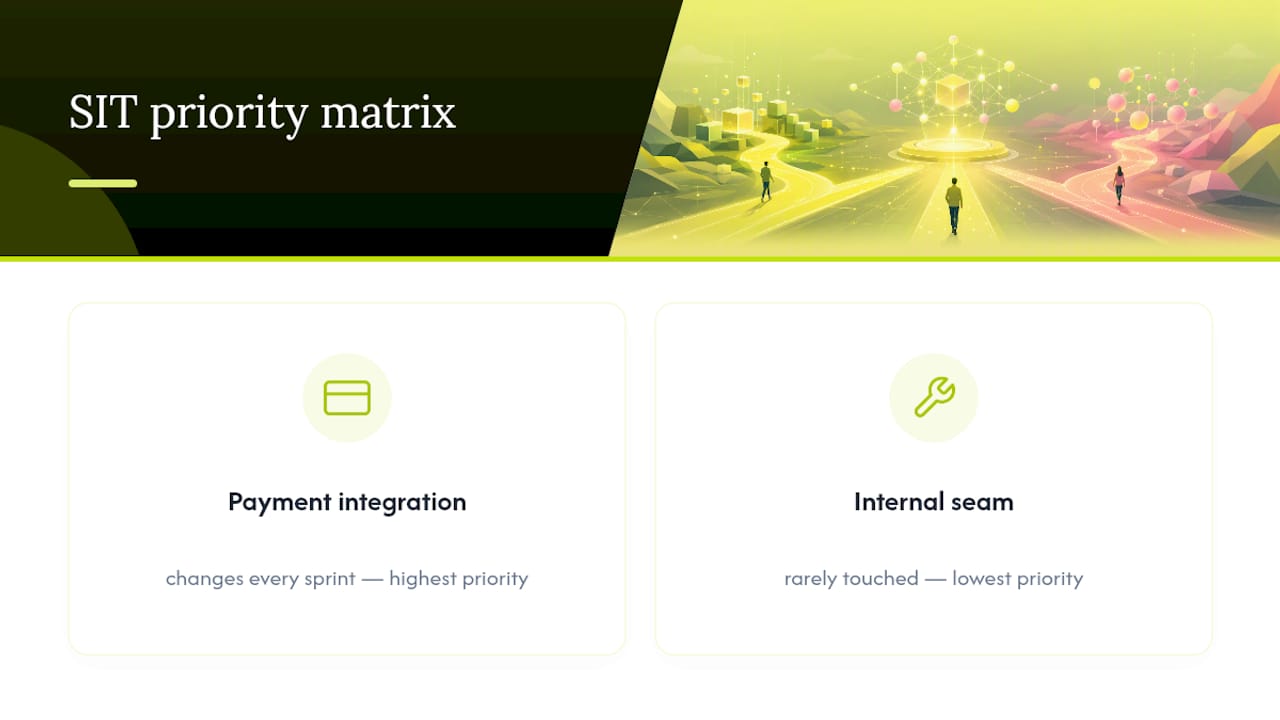
Not every seam deserves the same testing budget, so prioritize by blast radius (how many downstream systems break) multiplied by change frequency (how often that seam gets touched). A payment gateway integration that changes monthly and touches five systems outranks a rarely modified internal logging hook every time.
Placement in the pipeline matters as much as prioritization:
- Pull request stage: run a fast smoke subset, five to ten critical scenarios, to catch obvious breaks before merge.
- Merge to main: run the full SIT suite against a realistic environment.
- Nightly or pre-release: run extended scenarios, including third-party sandbox integrations that are too slow for every merge.
A workable go/no-go rule looks like this: no release proceeds if any critical-journey scenario fails without a documented, time-boxed waiver signed by the seam owner.
Pro Tip: Don’t just report pass/fail counts to release approvers. Attach the actual evidence, a captured request/response pair or trace ID, so a non-technical stakeholder can see what broke and why it matters.
Integration Testing Strategies: Top-Down, Bottom-Up, and Beyond
Four classic approaches to integration testing exist, and picking the wrong one for your architecture wastes weeks. Common strategies include top-down, bottom-up, big-bang, and hybrid approaches, with contract testing increasingly recommended for microservices to avoid deploying both sides of an integration for every test run.
- Top-down: test from the UI or entry point downward, using stubs for lower layers not yet built. Good for early user feedback, weak at catching low-level data bugs.
- Bottom-up: test foundational components first, using drivers to simulate callers. Strong for catching data and logic bugs early, slow to reveal integration issues with the UI.
- Big-bang: integrate everything at once and test the whole assembly. Fast to set up, brutal to debug when something fails, since you can’t isolate the source.
- Hybrid (sandwich): combine top-down and bottom-up, meeting in the middle. Balances speed and traceability but needs more coordination.
- Contract-driven testing: each service verifies it meets an agreed API contract without needing the real dependency running.
Teams with clear service ownership and frequent deploys should default to contract-driven testing with tools like Pact rather than big-bang integration. It’s cheaper to run, doesn’t require deploying every dependent service, and catches breaking changes at the source instead of downstream.
Building a Practical Integration Test Plan and Checklist
A repeatable SIT process starts from the business, not the codebase. Map the customer journeys that generate revenue or carry legal risk first, then trace every seam those journeys cross.
The checklist:
- List critical business journeys (checkout, onboarding, claims submission) and rank by revenue or compliance impact.
- Identify every seam each journey crosses: databases, third-party APIs, message queues, internal microservices.
- Assign a named owner to each seam, not a team name, an actual person accountable for the contract.
- Design scenarios covering the happy path, at least one failure mode, and one boundary condition per seam.
- Build or version the test fixtures and mocks needed, and store them alongside the code they represent.
- Execute the suite against an environment that mirrors production configuration as closely as possible.
- Capture evidence: logs, trace correlation IDs, and confirmed downstream side effects, not just a green checkmark.
- Publish a release evidence pack summarizing what passed, what didn’t, and what gaps remain.
- Tear down or reset environment state so the next run starts clean.
An enterprise SIT guide from Axian frames this well: start from business journeys, map seams to owners, and publish an evidence pack for release decisions, which turns SIT from a coverage exercise into an actual risk control. Aim for coverage of three to five critical journeys minimum before you worry about edge cases; a suite that tries to cover everything usually ends up covering nothing well because it runs too slowly to use.
| Checklist stage | What “done” looks like |
|---|---|
| Journey mapping | Ranked list of top revenue or compliance journeys |
| Seam identification | Every cross-system dependency named and owned |
| Scenario design | Happy path, one failure mode, one boundary case per seam |
| Evidence collection | Logs, trace IDs, and verified side effects attached to results |
| Release packaging | Evidence pack with explicit pass/fail and waiver notes |
Severity should always be framed in business terms in that evidence pack. “The order confirmation email service timed out” means more to a release approver than “assertion failed on line 214.”
Making SIT Reliable: Environments, CI/CD, and Automation Patterns
SIT only earns trust when it runs the same way every time, and that comes down to environment discipline more than test-writing skill. Integration testing needs to be built into CI/CD pipelines; without that automation, it turns into a manual bottleneck that slows releases and raises the odds defects slip through anyway.
Three patterns make this practical:
- Ephemeral containers: spin up real dependencies (a Postgres instance, a Kafka broker) fresh for each test run using Testcontainers, then destroy them. This avoids the drift that creeps into long-lived shared test environments.
- Service virtualization for external dependencies: tools like LocalStack simulate cloud services (S3, SQS) you don’t control, while WireMock stands in for third-party HTTP APIs you can’t spin up on demand.
- Tiered execution: run a fast smoke subset on every pull request, the full suite on merge to main, and extended third-party sandbox tests nightly. Parallelize by seam, not by test file, so a slow database suite doesn’t block a fast API contract suite.
Data isolation deserves its own attention. Reusing containers across test runs speeds things up but invites state leakage between tests. Reset seed data between runs, or use unique namespaces per test run, rather than relying on cleanup logic that inevitably gets skipped when a test crashes mid-run.
A flaky suite trains engineers to ignore failures, which defeats the entire purpose of the gate.*
Integration Testing Tools Mapped to Real Scenarios
The right tool depends on what kind of seam you’re testing, not personal preference. Common tools include Testcontainers, WireMock or MockServer, Pact, Postman, and test runners like JUnit and pytest, orchestrated through CI runners such as GitHub Actions or Jenkins.
- Service plus real database: spin up Testcontainers with Postgres or MySQL, run your actual repository layer against it, and verify a write is readable in the exact schema you’ll deploy.
- Outbound HTTP dependency: stub the third-party API with WireMock and assert your service handles a slow response, a 500 error, and a malformed payload, not just the happy path.
- Asynchronous messaging flow: publish a message to a test Kafka topic, then verify the consumer processes it and produces the expected side effect downstream.
Default to mocking when the real dependency is slow, costly, or outside your control, and default to running the real thing when the contract itself, serialization, connection handling, is what you’re trying to verify.
Common Challenges in Integration Testing and How to Fix Them
Most SIT programs fail for the same handful of reasons, and none of them require a new tool to fix.
- Unrealistic test environments: config drift between test and production hides bugs until release day. Fix it by generating environments from the same infrastructure-as-code templates used in production.
- Brittle mocks: mocks that don’t get updated when the real API changes give false confidence. Version mocks and contracts alongside the code, and fail the build when a contract test detects drift.
- Flaky test data: shared databases with leftover state from previous runs cause intermittent failures. Isolate data per run instead of relying on cleanup scripts.
- Unclear seam ownership: when no one owns an integration point, failures get triaged slowly or ignored. Assign a named owner to every documented seam.
- Late contract discovery: finding out two services disagree on a field format during a live deploy is expensive. Catch it earlier with contract testing using Pact, which verifies consumer and provider expectations without deploying both sides together.
A useful sizing guideline: many services need somewhere in the range of 20 to 50 integration tests, not hundreds, to keep a suite fast enough to actually run on every merge. Track three metrics over time: flaky-test rate, average triage time when something fails, and coverage against runtime, so you can tell whether the suite is getting more valuable or just heavier.
How Quicktoimpress Builds SIT Into Growth Engineering Work
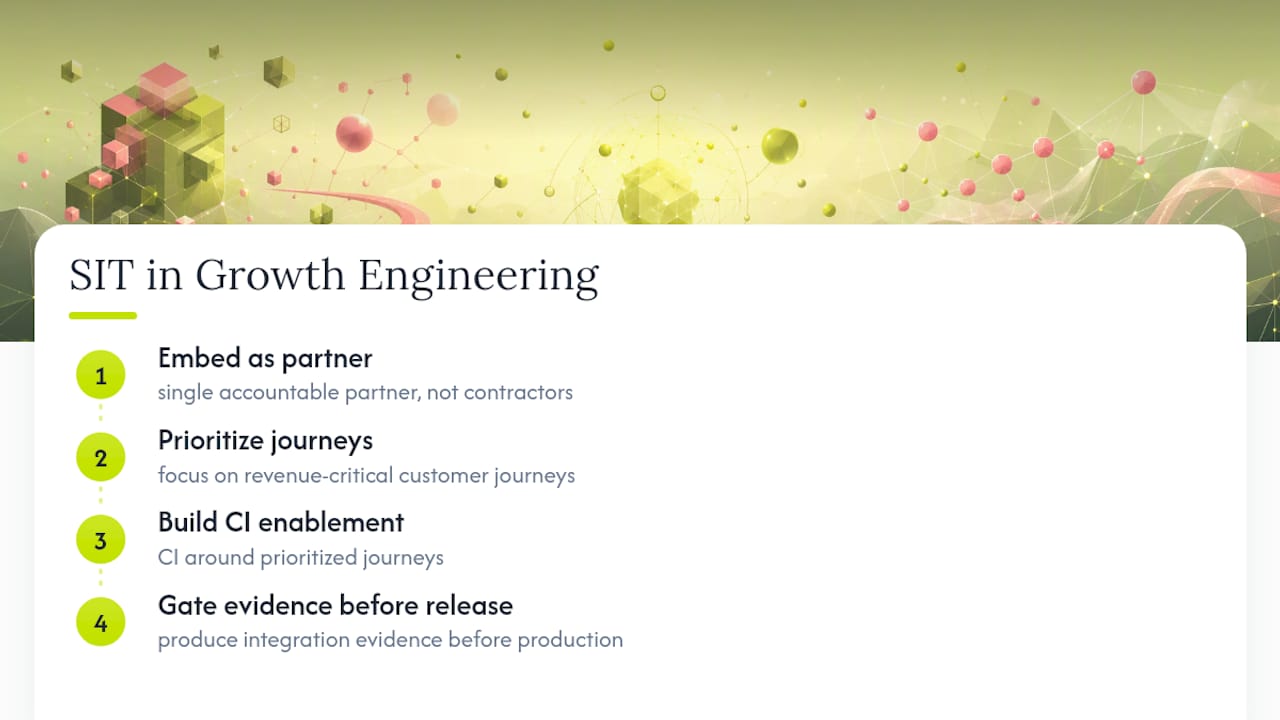
Some growth engineering partners embed with marketing, revenue, and technology teams as one accountable partner rather than a rotating cast of contractors, and integration testing shows up constantly in that work. Every platform build, whether it’s a Shopify storefront talking to a fulfillment API or a HubSpot instance syncing with Salesforce, depends on seams that behave correctly under real load, not just in a demo.
A typical engagement prioritizes the customer journeys that matter most to revenue, builds CI enablement around them, and produces the kind of evidence gate described above before anything ships to production. For multi-location brands running dozens of connected storefronts and CRM instances, that governance model is often the difference between a quiet release and a costly one.
The Case for Treating SIT as Risk Control, Not a Coverage Contest
Most teams still treat integration testing as a box to check, run the suite, see green, ship it. That’s backwards. The suite’s value comes from whether it tells a release approver something true about business risk, not from how many scenarios it covers.
The conventional advice to “test more integrations” misses the actual lesson from teams doing this well: prioritize by blast radius and change frequency, not by what’s easiest to automate. A rarely touched internal seam doesn’t need the same rigor as a payment integration that changes every sprint. Treating every seam equally is how suites become slow, bloated, and eventually ignored.
The other place conventional wisdom falls short is contracts. Most teams write integration tests but never version the contracts those tests depend on, which means a silent API change breaks tests without anyone understanding why until someone digs through logs. Make contracts first-class artifacts, versioned, reviewed, owned, and the entire suite becomes more honest about what it actually protects.
If you take one thing from this: map your top three business journeys to their seams before writing another test. Everything else follows from that map.
— Service
When SIT Gaps Signal It’s Time to Bring in a Partner
Quicktoimpress is the alternative to a traditional agency for teams stuck rebuilding the same broken integrations release after release. Rather than a project handed off and forgotten, you get one accountable partner who stays involved through strategy, CI/CD enablement, and the actual engineering, covering integration architecture, automation, and revenue operations across HubSpot, Salesforce, Pardot, and ActiveCampaign.
If your team keeps hitting the same signals, no clear seam ownership, release gates that pass and still break in production, integrations that only one person understands, that’s usually the moment an outside partner pays for itself faster than another internal hire. Quicktoimpress works with multi-location brands, B2B SaaS companies, and enterprise commerce organizations managing exactly this kind of complexity.
Check current engagement models and pricing or start with a conversation about your platform at Quicktoimpress.